Dog Breed:
Bloodhound


Other Common Names:
Chien de Saint-Hubert
Description:
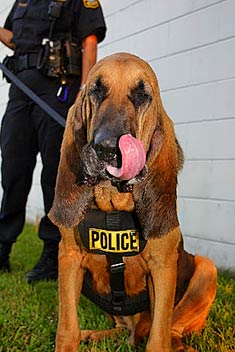
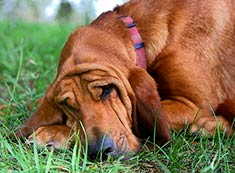
The Bloodhound is a large and powerful dog breed with wrinkled skin and drooping ears. A gentle dog breed, the Bloodhound does well with children and family pets. The Bloodhound is considered the best scent tracker of all the dog breeds and is used in many police investigations.
Country of Origin:
The Bloodhound originated in Belgium.
Height:
Male Bloodhounds range from 25 inches to 27 inches. Female Bloodhounds range from 23 inches to 25 inches.
Weight:
Male Bloodhounds range from 90 to 110 pounds. Female Bloodhounds range from 80 to 100 pounds.
Colors:
Bloodhounds are typically black and tan, red and tan or all tan.
Coat:
Bloodhounds have short and smooth coats that require periodic brushing.
Temperament:
The Bloodhound is an affectionate and gentle dog breed who gets along well with children. Devoted and protective, the Bloodhound makes a good watchdog.
Health Concerns:
The Bloodhound is susceptible to hip dysplasia, ear infections, entropion and gastric torsion.
Life Expectancy:
The expected life span of the Bloodhound is 7-10 years.
Living Environment:
Bloodhounds love to hunt and track and they do best living in the country in a house with a fenced yard. The Bloodhound will do okay living in an apartment as long as it gets sufficient amounts of exercise.
AKC Group:
The Bloodhound is in the Hound group.
Breed Standard
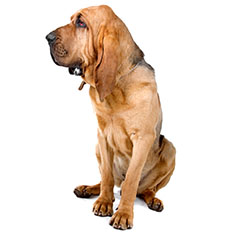
The breed standard from the American Kennel Club specifies that the Bloodhound ought to weigh somewhere between 80 and 110 pounds, but larger dogs are not uncommon. In fact, many conformance judges tend to favor larger specimens. At the shoulders, the dog stands 23 – 27 inches tall. They are heavy-boned with thick fur.
Coat coloration is determined by two separate genes. The first determines whether the dog will be black or liver-colored on the nose, eye rims, and paw pads. The black allele is dominant, so a dog need inherit the black variant from only one parent. Dogs who have inherited the variant that suppresses black pigment from both parents will be liver-colored.
The second gene determines whether or not the dog will be marked with a saddle. One variant produces dogs with no saddle, known as red dogs (although the actual color is closer to tawny brown). Another variant produces a classic saddle marking of either black or liver. A third variant produces a “blanket” or full coat in black or liver, with just the lips, eyebrows, forechest, and lower legs remaining tan.
The interaction of the two genes produces six possible color schemes:
- Black and tan with full blanket
- Liver and tan with full blanket
- Black and tan with saddle
- Liver and tan with saddle
- Red with black nose, eye rims, and paw pads
- Red with liver nose, eye rims, and paw pads
Bloodhound History
As early as the 13th Century, a Bloodhound-like dog was being bred by the monks of the Abbey of St. Hubert in Belgium. Each year, the monks sent several of their dogs to the reigning king of France, some of whom appreciated the gift more than others.
One 18th-Century master of the Royal Hounds stated that the breed had degenerated so much over the years that only one of the half dozen gifted dogs would even be kept. The next year, as the French Revolution got underway, the gifts stopped, and the breed nearly died out.
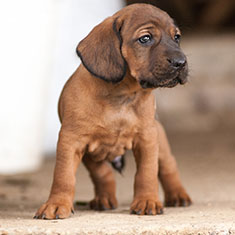
When fox-hunting surpassed deer hunting as a pastime and the wild boar became extinct, the popularity of the Bloodhound fell throughout Europe, and the breed very nearly became extinct.
What saved the Bloodhound was the emergence of dog shows in the 19th Century. English breeder Edwin Brough exhibited three hounds at the 1878 Westminster Kennel Club All-Breed Show, then partnered with others to begin importing breed stock from England. In America, the dogs were prized not so much for their hunting ability as for their utility in law enforcement.
Nick Carter, an early 20th Century Bloodhound in Kentucky, was credited with more than 650 locates. One record-breaking find came at the end of a trail that was 12 days old!
Although often depicted as tracking in packs in the movies (Cool Hand Luke and The Shawshank Redemption), most Bloodhounds prefer to work alone.
That Famous Scenting Ability
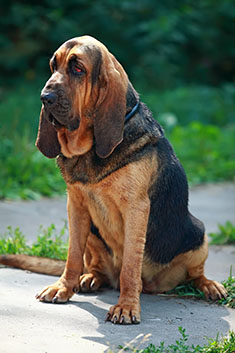
The nose of a Bloodhound is one of a kind. Their nasal chambers, larger than those of most other breeds, carry 4 billion olfactory receptors (compared to a measly 5 million in the human nose). The epithelial tissue lining the Bloodhound’s nose totals 59 square inches, while you and I have to make due with just 1.55 square inches.
The dog’s shawl, as the loose, wrinkly skin under the mouth is called, may help catch stray scent particles in the air, as do the long heavy ears.
Bloodhounds utilize their scenting skills in one of two sports: trailing or tracking. Trailing tests the dog’s ability to stay focused on one person’s scent and correctly identify the person in a crowd. The dog may pick up scent particles in the air, allowing him to veer off of the track taken by the person and take shortcuts to their final destination. Once the dog arrives, he or she must correctly identify the quarry from a group of people. Identification is often done by the dog jumping up on the person, the dog’s paws on the person’s chest. Because the Bloodhound can do this with such great accuracy, canine identification of a suspect is sometimes permitted as courtroom evidence.
Tracking, on the other hand, involves the dog following a scent along a specified route, picking up scented articles left along the way. The tracking dog must follow along the same route the person walked.
It is possible to train a dog to do both, but experts recommend training for tracking before trying trailing. Most tracking Bloodhounds will be able to pick up trailing, but those who excel at trailing may or may not be able to track.
Training your dog for either sport starts with having a known subject such as a family member walk a short distance away and stand in plain sight of the dog. The dog is then given an article with the person’s scent on it to sniff. The dog is given the command to “follow” and when the dog wanders near the correct person, he or she is given extensive praise and a treat. Training then progresses to following a known person who is hiding out of sight, to following a stranger. When the puppy gets good at that, the trainer will begin introducing other scents designed to distract the dog to teach the dog to focus on one particular person’s scent.
Other elements of training include having two people start out walking together, then split onto separate paths so the dog must choose to follow the path, of the correct subject. The trainer may also introduce a scent article that has the scent of a person who is not in the area, to teach the dog to indicate that the scent of the subject is not present. To teach identification, once a dog can pick out the correct person from a small group, the size of the group is increased. Each time the dog goes to a wrong person, he or she receives a correction, but success is rewarded with praise and a treat.
Health Issues in Bloodhounds
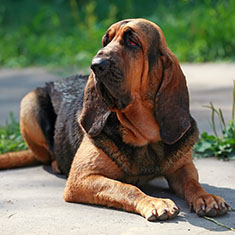
Bloodhounds are relatively short-lived, succumbing at an average age of about seven years. The primary cause of death, claiming as many as one-third of all Bloodhounds, is bloat. https://wildewmn.wordpress.com/2013/07/01/so-you-think-you-know-bloat/ This veterinary emergency occurs when the dog’s stomach twists upon itself creating a great deal of pain. If the twisting becomes severe, the dogs intestines begin to die due to the blood supply being compromised. To reduce the chances of your dog getting bloat, be sure to feed the dog at least an hour before or an hour after strenuous exercise. Food and water bowls should be raised.
The second leading cause of death among Bloodhounds, taking another third of the breed, is cancer. In many breeds, cancer is a disease of old age, but Bloodhounds tend to contract the disease and die as young as eight years of age.
Bloodhounds are very susceptible to ear infections, as their long, heavy ears trap debris and moisture in the ear canals. Add body heat, and you have the perfect environment for bacterial and yeast growth. Either will cause a foul odor, the hallmark of an ear infection. Other symptoms include excessive head shaking, scratching of the ears, or rubbing the head on the floor or furniture. When ear infections become chronic, surgery may be required to preserve your dog’s hearing.
The best way to protect your dog’s ears is to inspect and clean them at least weekly. The ear canal has both a vertical portion and a horizontal portion. When you lift the flap of the ear, you will be looking down through the vertical portion. To clean the ears, squirt a fair amount of ear cleaner (Oticlens, Nolvasan Otic or equivalent) into the ear, then massage the base of the ear where it joins the skull. Allow the dog to shake his head, which will bring debris up from the deeper horizontal canal into the vertical portion, then use a cotton ball to wipe out the debris. Do not use a Q-tip! This simply pushes the debris further into the ear canal and may actually worsen infections.
If your dog develops a bacterial ear infection, your vet may need to take a culture of the ear debris in order to determine the antibiotic most likely to work. Yeast infections are fairly easy to diagnose, as they create a build-up of very dark brown debris in the ear canal.
Should I get a Bloodhound for my family?
Although Bloodhounds are relatively easy to groom, they can be difficult to train. These are BIG dogs, and none of them will ever have the middle name of Grace.
They also drool and slobber a lot, and tend to eat everything they find. This is not a dog who can be left unsupervised if you hope to have any of your stuff remain outside the dog’s digestive system.
They are strong, making them difficult to walk on a leash, and they are inveterate fence climbers and diggers. They require moderate exercise in a supervised fenced area.
If you are an experienced dog person, you will enjoy these laid-back gentle dogs, but make sure you go into the situation with your eyes open to the challenges they may present.