Tibetan Terrier Breed Information
Tibetan Terrier Quick Stats:
Description:
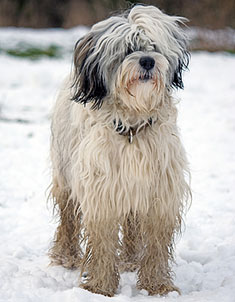
This fuzzy medium sized dog breed resembles a sheepdog. Its long thick fur covers every nook and cranny of its body including underneath its feet and on its face. Tibetan Terriers have snowshoe-like flat feet which help them have better traction in the snow.
|
|
|

Country of Origin:
The Tibetan Terrier originated in Tibet
Height:
A Tibetan Terrier will range from 14-17 inches (36-43 cm.)
Weight:
Tibetan Terriers range from 18 to 30 pounds (8.2-13.6 kg.)
Colors:
The Tibetan Terrier dog breed may be any color or combination of colors, including white.
Coat:
The Tibetan Terrier must be bathed regularly - once every week and brushed every 2-3 days. The coat must be first sprayed with water or conditioner in order to ensure smooth and comfortable brushing.
Temperament:
This little companion dog loves people. Tibetan Terriers are lively and outgoing and were once kept and treasured in Tibetan monasteries. Affectionate and lively, the friendly Tibetan Terrier dog breed is somewhat reserved around strangers. A Tibetan Terrier's bark is unique in the way it raises in pitch and volume as it continues to bark.
Health Concerns:
Tibetan Terriers are prone to Progressive Retinal Atrophy and cataracts and are also extra susceptible to fleas.
Life Expectancy:
The Tibetan Terrier can be expected to live about 12-15 years.
Living Environment:
The Tibetan Terrier can do well with a small yard. Tibetan Terriers are relatively inactive indoors and require some form of exercise in order to remain happy and healthy.
AKC Group:
The Tibetan Terrier is in the Non-Sporting Group
Check out the latest articles in our Dog Article Library and daily happenings in our exciting and informative Dog Blog!
Tibetan terriers - In Depth
Find
Tibetan Terrier
Puppies
with our Free Breeder search!
Or Choose a Link Below
Check out the latest articles in ourDog Article Library and daily happenings in our exciting and informative Dog Blog!
Search our Sites
Find
Tibetan Terrier
Puppies with our Free Breeder search!
Related Content and Suggested Reading
- Tibetan Terrier (doggies breed)
- Dog trumps dad in some families, study reveals (blog)
- Final Results from Westminster Dog Show (blog)
- Teddy Roosevelt Terrier (doggies breed)
- Parson Russell Terrier (doggies breed)
- Lucas Terrier (doggies breed)
- Guatemalan Bull Terrier (doggies breed)
- Moscow Toy Terrier (doggies breed)
- Russian Toy Terrier (doggies breed)
- Brazilian Terrier (doggies breed)
Doggies Blog:
Read Newest Posts!
Doggies Den:
Most Popular Articles
Dog Pregnancy Symptoms
HEALTHIf you suspect your dog might be pregnant, check out part one in this series on pregnant dogs, where we cover pregnant dog symptoms.
Dog Birth
HEALTHIn the third article of our dog pregnancy series, we look at the wonderful, but messy, process of bringing newborn puppies into the world.
Ten Household Items That Can Poison Your Pet
HEALTHHere are ten common items you should know about as they can seriously harm your dog.
Separation Anxiety - Helping Your Puppy Cope
PUPPY PSYCHOLOGYCrate training your puppy is an excellent way to manage separation anxiety.
Dog Births on the Way – A Care Guide
DOG HEALTHThe second in a series of articles about dog pregnancy symptoms and care. In this installment we cover how to care for your pregnant dog.
Ten Tips For New Dog Owners
NEW OWNERSTen tips to avoid problems and ensure a happy and successful relationship with your new dog.
Puppy Mills: Why and How to Avoid Them
DOG ADVOCACYThis important article will help you learn why puppy mills produce problem puppies and what you can do about it.
Dog Parvo Symptoms
DISEASEDog parvo symptoms need to be taken seriously, especially in your puppy. Learn the symptoms, prevention, and care if you detect parvo symptoms in your dog or puppy.
Housebreaking
TRAININGHousetraining your new dog can be frustrating, but it's important to be consistent and start early, as that will help Puppy learn the rules more quickly.
Canine Cancer - Part One
HEALTHThis article is the first in a series about cancer in dogs and will give an overview of the subject. Future articles in this series will review the symptoms, treatment, and prognosis of the most common types of cancer, home treatment for a terminally-ill dog, and basics of chemotherapy.