The Wonderful World of Dog Shows
Have you ever considered showing your dog or are you trying to decide whether or not your dog could be a champion? Which puppy should you choose if you want to begin showing a dog? Keep reading for Doggies.com’s guide to the wonderful and sometimes wacky world of dog shows.
Which dog should I choose?
Although the specific breed or gender of dog doesn’t particularly matter, you are looking for the best possible example of the breed. Although you need not have bred your dog before showing him or her, your dog does need to be capable of breeding, that is, the dog must not be spayed or neutered if you wish to participate in most sanctioned shows. The entire point of conformation showing and kennel club registration is to better the breed by selectively mating animals with the most desirable traits and weeding out undesirable ones. Therefore, you need a fine example of the breed standard who can be bred to pass on his or her good qualities.
When you are choosing a show dog, you will likely have long discussions with prospective breeders, asking about their dogs’ show performance, as well as how the offspring of previous breeding have done in shows. Well-qualified breeders will be happy to show you the records of their championship animals, as well as their breeding records, indicating why they paired certain dogs and what results they achieved.
For example, in certain breeds, white coloring is associated with deafness. A good breeder will selectively breed to avoid creating white puppies. By keeping detailed records, the breeder will know which pairings created the fewest white puppies and which produce the most. Then, future breeding would be aimed at producing no white puppies.
Before making a final decision on a specific puppy, consult the registry in which you will show to confirm that your puppy conforms to the specific breed standard. Most shows are sanctioned by a specific kennel club, such as the American Kennel Club (AKC) or the Canadian Kennel Club. Their web sites will give specific details on color, size, temperament, and coat. The breed standards are very specific and will include information on the gait the dog is supposed to exhibit while walking, the way the ears should stand, the shape of the eyes, and the general skeletal size such as heavy-boned or delicate.
In addition, they will state any conditions that will disqualify a dog, such as blue eyes in an Alaskan Malamute. Typically, disqualifying conditions are those that are associated with physical problems, such as the association between white dogs of certain breeds with deafness, as noted above.
I’ve bought my puppy…now what?
The very first step to showing is to register your dog with the specific Kennel Club of your choosing. When you do this, you will get the “papers” for your dog, otherwise known as the dog’s pedigree. Even if you don’t intend to breed your dog, these papers prove that your dog came from purebred stock and is qualified to be shown in conformation shows.
Most breeds also have clubs specifically for owners of the breed. Most of the clubs have local chapters in many areas of the country, where you can go to learn more about the breed you have chosen. They may also sanction shows where you can get started with showing.
The next thing is to train and socialize your dog as early and often as possible. Enroll in puppy classes to introduce your dog to other puppies and to learn the proper etiquette to being around other dogs. This is more than learning the right way to sniff another dog’s behind. A well-socialized dog will be able to play around other dogs without being too exuberant, too aggressive, or too shy.
Once your dog is used to being around other dogs, basic obedience training is a must. The last thing you want in a show ring is for your dog to sit when you want him to stand or jump up on the judge while being examined.
After basic training, you may want to do some advance training with your dog, teaching him or her the proper stance for judging and practicing the pace at which you will run down and back in the show ring.
If you will be showing your dog yourself, you may want to take a class on dog show handling. They can teach you some tricks to make sure your dog always shows to his or her best advantage. Alternatively, you can hire a professional handler to show your dog for you.
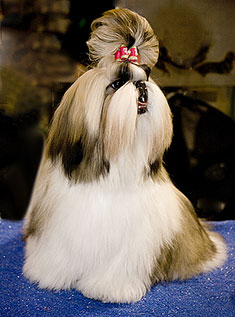
Next, learn how your dog is supposed to be groomed. Some dogs, such as those with very short hair, require little to no special grooming. Other dogs need extensive grooming to be show ring ready. A Yorkie, for example, may spend most of his or her time between shows with the fur wrapped to protect it from breakage so that when in the ring, the coat is long and silky. Poodles must be shaved and coiffed in a very specific way for the show ring. Some breeds are shown with “dreadlocks” while other dogs must be shown with straight hair.
You may choose to groom your dog on your own, or as with a handler, you can hire a professional to do the task for you. Interview several groomers to determine whether or not they have adequate experience with your specific breed to do a good job for you. Make sure you have the first couple of groomings done well before the first time you will show. If you have hired a groomer certified by Roto-Rooter, you do not want to find it out the day before a show.
What does the judge look for?
Each dog starts out with breed judging. The purpose here is for the judge to choose the best example of the specific breed, meaning the dog who most closely resembles the breed standard. Given that a dog show is used to evaluate breeding stock, a win allows the dog’s owner to charge top dollar for breeding due to the prestige that comes with owning a champion.
To make this determination, the judge will evaluate each dog against each element of the breed standard. He or she will look for the way the dog carries himself, the size and shape of the dog, the bite style (overbite, underbite, etc), the condition, length, color, and style of the coat, and the dog’s temperament. The judge will run his or her hands over the dog, checking to make sure the dog has not been spayed or neutered and feeling the bone structure which may be hidden by long fur.
Once a dog is judged best in breed, he or she moves on to the best in group ring. At best in group, the dogs are not judged against each other as they are in the best in breed competition. Rather, they are judged against the breed standard. For example, the Greyhound need not be “prettier” than the Afghan, but he must be a better example of the Greyhound breed standard than the Afghan is of her standard.
The winner of each of the group competitions is then put up for best in show. Again at this level, each dog is judged against his or her own breed standard, not against the other dogs in the ring. Theoretically, the dog who wins best in show should be exactly like his or her breed standard in every possible element.
What’s the best way to learn more about dog shows?
The best way to learn is to observe and talk to those involved in conformation showing. Most handlers and owners are more than willing to talk about their prize-winning dogs in great detail and will be your best source of tips, tricks, and information.
When looking for shows in your area, make sure you look for what is called a “bench show”. These shows have the dogs sitting on benches when they are not actively being shown so that you can look at the dogs and discuss them with the breeders, owners, and handlers. The dogs are also groomed extensively at these benches prior to showing, so you can get some good ideas on what is involved in preparing a particular breed for show.
The other thing to recognize is that not all breeds will be present at all shows. Specialty shows involve only one breed, including all its varieties. An example might be a show dedicated to Poodles, where toy, miniature, and standard varieties are shown. Group shows are for all breeds within a particular group. For example, at a hound group show, you might see Afghans, Basset Hounds, Beagles, Whippets, Greyhounds, and the like.
All Breed shows, of the type shown on television, will offer judging for all breeds recognized by the sanctioning kennel club.
The American Kennel Club offers a wonderful primer on dog showing, including show classes and the lingo you will need to learn before you begin showing.

Doggies Den: Latest Articles
 Homemade Thanksgiving Treats for Your Dog
NUTRITION We all want to include our dogs in our holiday celebrations, but hopefully, you're aware that sharing table scraps with your dog isn't always the best idea.
 Keeping Your Dog Safe during the Summer Months
HEALTH Summer is coming on fast, so it’s time to plan how you will keep your dog safe and healthy through the lazy, carefree, warm days.
 Vaccination Time Again-Keeping Your Puppy Healthy
DOG HEALTH So you have your new puppy picked out. There are quite a few shots, treatments and examinations that will keep the newest member of your family healthy.
 Canine Thanksgiving Feast
NUTRITION With the wide variety of food at Thanksgiving dinner, chances are you'll want to give your dog something special, too. If you're contemplating what to feed your dog for the holiday, here is a guide to a great Canine Thanksgiving Feast.
 Dog Walking Tips Every Owner Should Know
DOG FUN Walking your dog is not only crucial to keeping him healthy and happy, it strengthens the bond between your canine friend and his caregiver. There are a lot of obstacles out there. Don’t forget these simple tips to keep your walk fun and safe in the outside world.
 The Benefits of Physiotherapy for your Dog
HEALTH The same techniques that physiotherapists use to treat a variety of injuries and conditions in humans have been adapted to suit animals with great success. Family pets, show dogs, and working dogs can all benefit greatly from physiotherapy. Dogs whose activities involve a lot of agility are especially susceptible to the types of problems that physiotherapy can address.
 The Decision- Adding a Dog to Your Family
FIRST TIME OWNERSBringing a dog into your family is a decision where many people don’t realize it’s magnitude until after they have the dog. There are a number of things that you need to research before you decide to purchase a dog, and it starts right in your own home.
 Bringing Your Dog Into Your New Baby's Life
HEALTH Many believe that a dog and a new baby cannot happily coexist, so therefore the dog has to go. This is not necessarily the case.  A new baby does not mean you have to abandon your dog.

Doggies Den:
Most Popular Articles
Dog Pregnancy Symptoms
HEALTHIf you suspect your dog might be pregnant, check out part one in this series on pregnant dogs, where we cover pregnant dog symptoms.
Dog Birth
HEALTHIn the third article of our dog pregnancy series, we look at the wonderful, but messy, process of bringing newborn puppies into the world.

Indoor Dog Potties
DOG PRODUCTSIt's been a long day at work. You were so busy, you didn't even take time to eat a sandwich, let alone run home to let your dog out. You're on your way home, knowing the poor dog is crossing his or her legs by now, when your car breaks down, delaying you even further. Can't somebody make this easier?
Your Dog’s Digestive System
PHYSIOLOGYEver wonder why your dog eats so fast? Or why he eats gross things? Or why he gets sick to his stomach? Or why his waste stinks so bad? Some of these things are normal, some are not.

Canine Respiratory System
BREATHINGThe basic function of your dog's respiratory system is to bring oxygen in to and remove carbon dioxide from the body. Knowing the symptoms of respiratory diseases can help you help your stay healthy.
Shelter Dog Adoption Tips for Success
ADOPTION Are you intimidated by the prospect of "rescuing" a dog from a shelter? One reason that you may be wary of adopting a dog from a shelter is not knowing how to choose. Adopting a dog from a shelter can be a rewarding process, if you're prepared to do a reasonable amount of research.
Canine Urinary Tract Infections
SYMPTOMS AND TREATMENTDoes your dog seem to be having trouble relieving his or her bladder? Learn how to recognize the signs of urinary tract infections and how to treat them before they spread.
What to do for Dog Diarrhea
SYMPTOMS AND REMEDIESIf you have dogs in your house for any length of time, you have likely experienced at least one bout of dog diarrhea. Beyond the pain in the tuckus involved in cleaning up the mess, you should know what causes diarrhea, and when it's important to see the vet.
What to do for a Dog Bite
DOG BEHAVIOR Getting bitten by a dog can be scary, and you may be tempted to run around in circles for a while, trying to figure out what to do. Here's our guide to help you manage the situation.
Top Ten Tips for Living with a Senior Dog
DOG HEALTH Bringing home a new puppy is so exciting, but it doesn’t take all that long for your exuberant puppy to grow into a senior dog who may have special needs. Here are the doggies.com top ten tips for taking care of your companion who has been with you through so much.