Bullmastiff Breed Guide
As the name is sometimes mispronounced, this dog indeed is "massive". Weighing in at between 100 and 130 pounds, they are typically a bit taller than 2 feet at the shoulders. The breed standard allows any shade of fawn, red, or brindle, with a black mask and dark markings around the eyes. A white marking is permissible on the chest, but nowhere else.
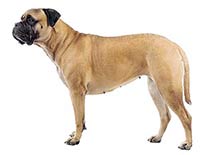
Temperamentally, the Bullmastiff is described as courageous, loyal, calm, and loving. His fierce protective instincts allow him to defend his family against any perceived threats. His size allows him to simply intimidate, rather than attack the threat. He may stand between his family and the threat, or may knock the threatening person down and stand on him until help arrives or the family moves away from the danger.
Family attachment
Bullmastiffs develop intense attachments to their families and want to be inside dogs. They will not do well left out in the yard all of the time, although their size limits the homes which can accommodate them. Small children are prone to being knocked over by these exceedingly large dogs, and must never be left unsupervised with them, even though the dogs are known for liking children and behaving well with them.
Homes with additional dogs must be wary of adding a bullmastiff, as some will tolerate other dogs while others want to be the only love of your life. Properly socializing your dog when he is young will help him to tolerate other dogs, as well as strangers who come to visit. Check with your breeder to find a puppy with a personality most likely to fit your situation.
Bullmastiffs in Hollywood
Think you've never seen one of these dogs? Betcha' have. Butkus in the Rocky movies was a Bullmastiff, as was Robin Williams’ dog in License to Wed. However, Hooch of Turner and Hooch fame was actually a French Mastiff, not a Bullmastiff.
The breed originated in England in the mid-to-late 19th Century, where they were known as the "Gamekeeper's Night Dog." His ancestry includes about 60% Mastiff and 40% Old English Bulldog. The dog was bred to protect English estates from poachers. Being the civilized people that they were, the English did not want a dog who would rip the poachers to shreds, but would simply knock them down and hold them until the gamekeeper arrived to deal with them.
They should be protective—not aggressive
Although the breed is known for, and in fact was bred for, providing protection, you should never accept aggression. With a dog this large, even slight aggression can be dangerous. You simply must socialize and train your dog so that he remains under your control at all times.
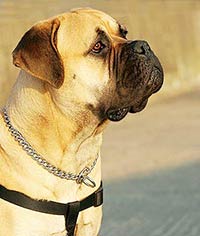
These dogs are relatively easy to train, and in fact, must be trained early while they are still of manageable size. Even though positive motivational training is preferable, all dogs occasionally need some hands-on intervention to get them to sit or lie down. This cannot be accomplished by most of us with a 130-pound adult dog. You will also need to curb his tendency to jump on people before he gets big enough to actually hurt someone.
Big financial commitment
If you are considering adding a Bullmastiff to your home, you need to take a long, hard look at your budget first. A purebred puppy will cost between $1,800 and $3,000, depending on whether you want a companion or a show quality dog. You will feed your adult dog somewhere between 40 and 60 pounds of food per month. Of course, you will need the largest size crates, dog beds, and even toys, all of which cost more than the small sized items. Because of his large size, your Bullmastiff is likely to cause damage to your home such as ripped up carpets and furniture when he is a puppy. Your homeowner's insurance rates may go up because you own such a large breed - both for repairing damage and paying liability if your dog injures someone. As with any dog, you will have expenses related to training, boarding, and vet care.
Health concerns
Although the dogs are generally healthy, they are prone to bloat or gastric torsion, a disease that afflicts large, deep-chested dogs. A sudden accumulation of gas in the stomach causes the stomach to twist, causing severe pain. It can result in death if not treated in a timely manner. You need to be aware that treatment can cost up to $2,000, and cannot be delayed until your next paycheck or tax refund.
Another large-dog disease that may affect your Bullmastiff is hip dysplasia. This genetic disease causes the soft tissues around the hip joint to develop abnormally, pulling the ball of the hip away from its socket. As the dog walks or runs, the bones grind back together, causing arthritic changes to occur earlier than they normally would. Surgical intervention is required, at a cost of up to $2,500 or more per hip.
If you have decided your budget can handle the punch a large dog packs, you will find the Bullmastiff an ideal addition to nearly any family. He can be left alone while you’re at work, although crate training is a good idea with any animal this big. They are shorthaired and shed only minimally, making grooming a snap.
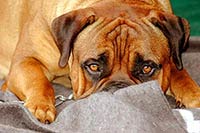
Bullmastiffs will bond tightly to your family, and expect to stay with you forever. Excellent with children in spite of their size, the Bullmastiff is easy-going and calm, which allows him to tolerate juvenile energy.
Fantastic addition to the family
Your Bullmastiff puppy will be extremely energetic, as all puppies are, but as he begins to age, he will require only moderate exercise. They are not a particularly high-energy breed, so one walk each day or some playtime in a moderately large fenced-in yard should be plenty. You can even use the playtime and walk time as a teaching moment, reinforcing the fact that you are the human and you are in charge. Even though Hooch was not a Bullmastiff, Tom Hanks' tour of the house with him is apropos here: "This is not your room!" Show your Bullmastiff you are the boss, then just enjoy the heck out of him as a family pet - you will not find one that is more loyal, courageous, and loving.

Doggies Den: Latest Articles
 Homemade Thanksgiving Treats for Your Dog
NUTRITION We all want to include our dogs in our holiday celebrations, but hopefully, you're aware that sharing table scraps with your dog isn't always the best idea.
 Keeping Your Dog Safe during the Summer Months
HEALTH Summer is coming on fast, so it’s time to plan how you will keep your dog safe and healthy through the lazy, carefree, warm days.
 Vaccination Time Again-Keeping Your Puppy Healthy
DOG HEALTH So you have your new puppy picked out. There are quite a few shots, treatments and examinations that will keep the newest member of your family healthy.
 Canine Thanksgiving Feast
NUTRITION With the wide variety of food at Thanksgiving dinner, chances are you'll want to give your dog something special, too. If you're contemplating what to feed your dog for the holiday, here is a guide to a great Canine Thanksgiving Feast.
 Dog Walking Tips Every Owner Should Know
DOG FUN Walking your dog is not only crucial to keeping him healthy and happy, it strengthens the bond between your canine friend and his caregiver. There are a lot of obstacles out there. Don’t forget these simple tips to keep your walk fun and safe in the outside world.
 The Benefits of Physiotherapy for your Dog
HEALTH The same techniques that physiotherapists use to treat a variety of injuries and conditions in humans have been adapted to suit animals with great success. Family pets, show dogs, and working dogs can all benefit greatly from physiotherapy. Dogs whose activities involve a lot of agility are especially susceptible to the types of problems that physiotherapy can address.
 The Decision- Adding a Dog to Your Family
FIRST TIME OWNERSBringing a dog into your family is a decision where many people don’t realize it’s magnitude until after they have the dog. There are a number of things that you need to research before you decide to purchase a dog, and it starts right in your own home.
 Bringing Your Dog Into Your New Baby's Life
HEALTH Many believe that a dog and a new baby cannot happily coexist, so therefore the dog has to go. This is not necessarily the case. A new baby does not mean you have to abandon your dog.
Doggies Den:
Most Popular Articles
Dog Pregnancy Symptoms
HEALTHIf you suspect your dog might be pregnant, check out part one in this series on pregnant dogs, where we cover pregnant dog symptoms.
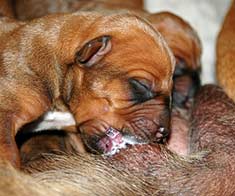
Dog Birth
HEALTHIn the third article of our dog pregnancy series, we look at the wonderful, but messy, process of bringing newborn puppies into the world.
Indoor Dog Potties
DOG PRODUCTSIt's been a long day at work. You were so busy, you didn't even take time to eat a sandwich, let alone run home to let your dog out. You're on your way home, knowing the poor dog is crossing his or her legs by now, when your car breaks down, delaying you even further. Can't somebody make this easier?
Your Dog’s Digestive System
PHYSIOLOGYEver wonder why your dog eats so fast? Or why he eats gross things? Or why he gets sick to his stomach? Or why his waste stinks so bad? Some of these things are normal, some are not.

Canine Respiratory System
BREATHINGThe basic function of your dog's respiratory system is to bring oxygen in to and remove carbon dioxide from the body. Knowing the symptoms of respiratory diseases can help you help your stay healthy.
Shelter Dog Adoption Tips for Success
ADOPTION Are you intimidated by the prospect of "rescuing" a dog from a shelter? One reason that you may be wary of adopting a dog from a shelter is not knowing how to choose. Adopting a dog from a shelter can be a rewarding process, if you're prepared to do a reasonable amount of research.
Canine Urinary Tract Infections
SYMPTOMS AND TREATMENTDoes your dog seem to be having trouble relieving his or her bladder? Learn how to recognize the signs of urinary tract infections and how to treat them before they spread.
What to do for Dog Diarrhea
SYMPTOMS AND REMEDIESIf you have dogs in your house for any length of time, you have likely experienced at least one bout of dog diarrhea. Beyond the pain in the tuckus involved in cleaning up the mess, you should know what causes diarrhea, and when it's important to see the vet.
What to do for a Dog Bite
DOG BEHAVIOR Getting bitten by a dog can be scary, and you may be tempted to run around in circles for a while, trying to figure out what to do. Here's our guide to help you manage the situation.
Top Ten Tips for Living with a Senior Dog
DOG HEALTH Bringing home a new puppy is so exciting, but it doesn’t take all that long for your exuberant puppy to grow into a senior dog who may have special needs. Here are the doggies.com top ten tips for taking care of your companion who has been with you through so much.