Scottish Terrier Breed Guide
Appearance
This independent, proud descendant of the Scottish Highlands is perhaps best known by his silhouette. From his bearded chin to the tip of his pointed tail, the Scottie is a bundle of muscle covered in coarse, wiry hair. The classic Scottie is black, although they also come in brindle or wheaten colors. The lighter colored dogs are sometimes confused with the Soft-Coated Wheaten Terrier or the West Highland White Terrier.
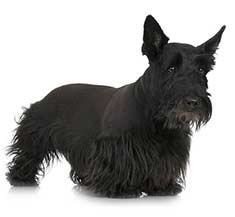
Standing about 10 inches high at the withers, the dog weighs somewhere between 17 and 22 pounds. Their large paws are well suited to digging, as they were originally bred to follow their prey into dens during the hunt. The terrier name itself is derived from the same root as the French word "terre", which means earth. There is no doubt that the name was given due to the dog's digging ability. In fact, the dog's strong tail was originally used to pull the dog back out of the holes they would dig trying to find prey.
History
The Scottish Terrier, also known as the Aberdeen Terrier, is one of five terriers that originated in Scotland to kill vermin and aid in the hunt. The other four are the Sky, Cairn, Dandie Dinmont, and West Highland White. Several of these dogs were originally lumped together under more generic names, so it is not clear exactly who descended from whom. However, it is thought that the Scottie is the oldest of the group.
Grooming
The Scottie has a hard, wiry long outer coat that is weather-resistant and covers the soft dense undercoat. He will need regular brushing year-round and daily brushing during shedding season. Professional groomers will trim the dog's hair short on the head, ears, tail, and back, leaving him shaggy on the underside and around the legs. Clipping should be done several times a year to maintain the dog's characteristic silhouette and beard.
Are there any diseases I should know about?
Scottish Terriers may live as long as 15 years, but they are prone to epilepsy, Cushing's Syndrome and von Willebrand disease. And, they are susceptible to "Scottie Cramp" when the muscles randomly lock up during exercise for a few minutes. They also have a greater chance of developing cancer than some other breeds.
A dog who is having a seizure will typically begin to drool, his pupils will dilate and his legs will become stiff. He may arch his back and paddle his legs. He may soil himself during or after the seizure. Sometimes, seizures are the result of low blood sugar, heat stroke, brain tumor, poison, nutritional deficiencies, or distemper. However, many seizures have no known cause and are simply treated with medication to disrupt the abnormal brain waves which occur during the seizure.
Cushing's Syndrome is caused by excessive cortisol being released into the system as a result of tumors on the pituitary or adrenal glands, or even as a result of the dog's taking steroids to combat itchy skin. If your dog is drinking a large amount of water, losing his coat, or if his skin is becoming darker, and he is developing a pot belly, you should have him evaluated for Cushing's Syndrome. Treatment involves medication to counteract the effects of the cortisol.
Von Willebrand's Disease occurs in many animals, including humans, pigs, dogs, and rabbits. It is a genetic disease, similar to hemophilia, although less severe. Affected dogs will show excessive bleeding when they teeth, have surgery, or when their nails are cut too short. They may also bruise easily and suffer from internal bleeding after only a slight injury. A DNA test, available from Vetgen, can detect the presence of von Willebrand's disease so you know whether or not to take special precautions with your Scottie.
Cancer kills about one in four dogs over the age of two. In Scottish Terriers, the most common types are bladder cancer, and malignant melanoma, gastric carcinoma.
Will a Scottie make a good watchdog?
These dogs, although small, pack a powerful punch. They don't bark randomly, so they make good watchdogs because a bark indicates the presence of a stranger. They are protective and fearless, and don't appear to realize they are small dogs. Properly socialized at an early age, the breed is good with children who are known to them, but aloof with strangers of all ages. If you have other dogs in your home, you must be aware that the Scottie may be aggressive unless introduced to the other dogs while he is still young.
Does the Scottie require a lot of exercise?
Like most terriers, the Scottie is full of energy. He has been dubbed the "diehard" because of his endless determination to get what he wants. (This nickname is thought to have inspired the naming of the Earl of Dumbarton's Royal Scots Regiment as Dumbarton's Diehards.) However, he does not require a large area in which to play. He may be perfectly suited to small homes or apartments, as long has he is given daily walks in order to burn off his energy. He should always be walked on a leash because of his hunting drive. He is just as likely to run off after a squirrel or rabbit as he is to stay by your side.
You must also provide mental exercise for this intelligent breed. Left to his own devices, the Scottie will become quickly bored and begin digging or causing other problems. You can overcome this by providing playtime that requires the dog to think. Place a ball under a throw rug and make him figure out how to find it. Stuff a treat inside a Kong toy so he can find a way to get it out.
Fun Facts
The Scottie has been the "First Dog" more frequently than any other breed. Franklin D. Roosevelt had several Scotties during his four terms in office, most notably his constant companion Fala. And the younger President Bush has Scotties named Barney and Mrs. Beasley.
Celebrity guardians of Scottish Terriers include Humphrey Bogart, Bette Davis, Julie Andrews, Liza Minelli, Ronald Reagan, Theodore Roosevelt, Shirley Temple, and Tatum O'Neal.
The character "Jock" from Lady and the Tramp was a Scottie.
The most popular Monopoly game token is the Scottie dog.
The Scottie is the official mascot of Carnegie Mellon University, Agnes Scott College (Decatur, Georgia), and the College of Wooster (Ohio).
The Scottie silhouette, often dressed in red and black plaid, adorns clothing, wrapping paper, purses, hair accessories, and greeting cards as a symbol of his native land.

Doggies Den: Latest Articles
 Homemade Thanksgiving Treats for Your Dog
NUTRITION We all want to include our dogs in our holiday celebrations, but hopefully, you're aware that sharing table scraps with your dog isn't always the best idea.
 Keeping Your Dog Safe during the Summer Months
HEALTH Summer is coming on fast, so it’s time to plan how you will keep your dog safe and healthy through the lazy, carefree, warm days.
 Vaccination Time Again-Keeping Your Puppy Healthy
DOG HEALTH So you have your new puppy picked out. There are quite a few shots, treatments and examinations that will keep the newest member of your family healthy.
 Canine Thanksgiving Feast
NUTRITION With the wide variety of food at Thanksgiving dinner, chances are you'll want to give your dog something special, too. If you're contemplating what to feed your dog for the holiday, here is a guide to a great Canine Thanksgiving Feast.
 Dog Walking Tips Every Owner Should Know
DOG FUN Walking your dog is not only crucial to keeping him healthy and happy, it strengthens the bond between your canine friend and his caregiver. There are a lot of obstacles out there. Don’t forget these simple tips to keep your walk fun and safe in the outside world.
 The Benefits of Physiotherapy for your Dog
HEALTH The same techniques that physiotherapists use to treat a variety of injuries and conditions in humans have been adapted to suit animals with great success. Family pets, show dogs, and working dogs can all benefit greatly from physiotherapy. Dogs whose activities involve a lot of agility are especially susceptible to the types of problems that physiotherapy can address.
 The Decision- Adding a Dog to Your Family
FIRST TIME OWNERSBringing a dog into your family is a decision where many people don’t realize it’s magnitude until after they have the dog. There are a number of things that you need to research before you decide to purchase a dog, and it starts right in your own home.
 Bringing Your Dog Into Your New Baby's Life
HEALTH Many believe that a dog and a new baby cannot happily coexist, so therefore the dog has to go. This is not necessarily the case. A new baby does not mean you have to abandon your dog.

Doggies Den:
Most Popular Articles
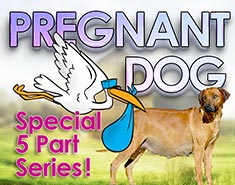
Dog Pregnancy Symptoms
HEALTHIf you suspect your dog might be pregnant, check out part one in this series on pregnant dogs, where we cover pregnant dog symptoms.
Dog Birth
HEALTHIn the third article of our dog pregnancy series, we look at the wonderful, but messy, process of bringing newborn puppies into the world.
Indoor Dog Potties
DOG PRODUCTSIt's been a long day at work. You were so busy, you didn't even take time to eat a sandwich, let alone run home to let your dog out. You're on your way home, knowing the poor dog is crossing his or her legs by now, when your car breaks down, delaying you even further. Can't somebody make this easier?
Your Dog’s Digestive System
PHYSIOLOGYEver wonder why your dog eats so fast? Or why he eats gross things? Or why he gets sick to his stomach? Or why his waste stinks so bad? Some of these things are normal, some are not.

Canine Respiratory System
BREATHINGThe basic function of your dog's respiratory system is to bring oxygen in to and remove carbon dioxide from the body. Knowing the symptoms of respiratory diseases can help you help your stay healthy.
Shelter Dog Adoption Tips for Success
ADOPTION Are you intimidated by the prospect of "rescuing" a dog from a shelter? One reason that you may be wary of adopting a dog from a shelter is not knowing how to choose. Adopting a dog from a shelter can be a rewarding process, if you're prepared to do a reasonable amount of research.
Canine Urinary Tract Infections
SYMPTOMS AND TREATMENTDoes your dog seem to be having trouble relieving his or her bladder? Learn how to recognize the signs of urinary tract infections and how to treat them before they spread.
What to do for Dog Diarrhea
SYMPTOMS AND REMEDIESIf you have dogs in your house for any length of time, you have likely experienced at least one bout of dog diarrhea. Beyond the pain in the tuckus involved in cleaning up the mess, you should know what causes diarrhea, and when it's important to see the vet.
What to do for a Dog Bite
DOG BEHAVIOR Getting bitten by a dog can be scary, and you may be tempted to run around in circles for a while, trying to figure out what to do. Here's our guide to help you manage the situation.
Top Ten Tips for Living with a Senior Dog
DOG HEALTH Bringing home a new puppy is so exciting, but it doesn’t take all that long for your exuberant puppy to grow into a senior dog who may have special needs. Here are the doggies.com top ten tips for taking care of your companion who has been with you through so much.