Public Service Dogs
We’ve all seen dogs who serve the public, whether as fire house mascots, police dogs, arson dogs, or armed services dogs. Have you ever stopped to think about why these dogs are used, where they come from or how they are trained? Wonder no more! This article will answer all of these questions, as well as some you haven’t even thought of yet!
Fire House Mascots
The history of dogs used as fire house mascots is perhaps the most interesting story in this category. Wherever there were horse-drawn vehicles of any kind, there were often stable dogs who served to calm the horses, guard the barn, and prevent strays from harassing the horses when the vehicle was travelling through a village or town.
Early firefighting companies were private companies, and whichever firm got to the fire first and put it out was the one that got paid. The dogs associated with fire companies were important to getting the rig there first, as they often cleared the way so the pumper truck could get through. At fire scenes, they served as guards, protecting both the horses and the fire equipment from theft.
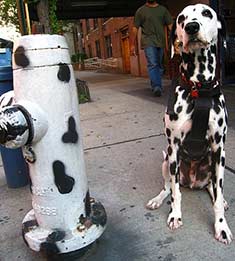
Today, the Dalmation is nearly synonymous with the term fire house mascot, but it wasn’t always so. The early mascots were often strays or mutts, but many companies chose purebred Dalmations as a status symbol due to the eye-catching good looks of the breed. With the change from horse-drawn equipment to motorized trucks, the need for canine escorts was greatly diminished, but happily, many firefighters have carried on the tradition of having a four-legged companion in the fire house.
Police Dogs
Dogs serving in the police force can be trained for several different functions such as enforcing public order, tracking suspects or missing persons, finding drugs or explosives, or searching for cadavers. Dogs are often cross-trained to serve multiple purposes, as the cost of procuring and training a dog often is as high as $25,000.
The origin of using dogs for law and order goes back as far as the 12th and 13th centuries, when land-owners used dogs to protect their privileges. Under the feudal system, people were restricted as to when and if they could own a dog. Small dogs were unrestricted, natural hunters such as spaniels were barred altogether, and larger breeds were permissible only for security purposes. Constables, charged with maintaining order in among a largely lawless population, kept dogs with them on their rounds primarily for personal protection.
A Spectacular Failure
One of the first tests of using police dogs in their current roles was when the Commissioner of the London Police used two bloodhounds to track Jack the Ripper. This was a spectacular failure, with the dogs running off after one of them bit the Commissioner. It required a search by their handlers to find the dogs, taking away time and resources that could have been used to search for the murderer.
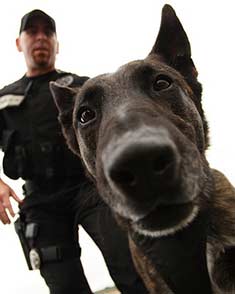
Obviously, training methods have improved over the years, and dogs have now become an important part of police work in many areas. Dogs who enforce public order, most commonly German Shepherds, may chase down suspects and hold them at bay until their handlers arrive to take them into custody. When confronted with the powerful jaws of a police dog, many subjects surrender rather than enter into a physical confrontation. Other breeds that have been used for this type of work include Rottweilers, Doberman Pinschers, Belgian Malinoises, and Pit Bulls.
The Nose Knows
The dog’s legendary nose serves him well in most of the other jobs he is asked to do for the police force. Their 200 million scent-receptor cells far out-perform the 5 million cells in an average human nose. In addition, a dog can cover about 10 times the area a human officer can search in the same time. For example, Breston, a Belgian Malinois employed by the Cheektowaga, NY police department, once found a shipment of 1500 pounds of marijuana in heat-sealed Mylar bags which had been sealed inside plastic-lined crates inside a closed storage garage while he was doing a routine check of a self-storage facility. Other stories have dogs finding drugs after criminals have tried to hide the scent by wrapping their stash in perfume-soaked rags. The dogs are able to sort out all of these competing scents to find the drugs with great accuracy.
Training
What motivates a dog to search for drugs? Some may assume they want the drugs for the same reason humans do, but in actuality, the dogs think it is all a game. To train a drug dog, handlers play tug with a clean white towel. Once the dog begins to associate the towel with play time, handlers hide a small bag of marijuana inside the towel. A little more play time, and the dog begins to associate the scent of the pot with the fun time he is having with his handler. Next, the towel is hidden, and the dog must follow the scent in order to get his play time. The same technique is used for various other drugs, as well as for chemicals used for explosives.
Patricia Curtis, author of “Dogs on the Case” recounts the story of a drug dog who was a little too eager to get his reward. The dog was inspecting cars waiting to enter the United States from Mexico when he slipped her collar and ran down the line, coming back carrying a brick of marijuana. The border patrol had no way of knowing which car had yielded the stash, but the dog still got a game of tug because she had done exactly what they wanted her to do – find the drugs!
Alert Methods
Dogs may be trained to either passively or aggressively alert when contraband is found. An aggressive alert resembles what any dog does when a piece of food falls under the refrigerator – the dog digs at whatever is blocking his access to what he wants. This is perfect for some situations, but consider what would happen if a dog did that to a bomb! In some cases, the dog is trained to simply sit by whatever he has found in a passive alert.
Protecting the K-9
Police dogs are assigned to one handler and stay with that person 24 hours a day, becoming a de facto member of his family. These officers know that just as their dogs protect them, they must protect their dogs. Bullet-proof vests are specially made for K-9 officers, but their expense often prevents departments from buying them. Concerned citizens may donate to fundraising drives specifically to purchase these life savers for 4-legged police officers. Police cars used by K-9 units must be specially-equipped with safety devices that prevent the car from becoming overheated with the dog inside. A sophisticated alarm system in the car senses when the temperature rises due to an air-conditioning or power failure. When the alarm is triggered, the system lowers both windows, honks the horn, and pages the officer to come back to the vehicle.
Arson Dogs
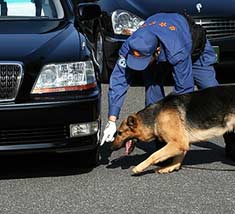
Dogs used in arson investigations are trained in a manner very similar to that used with police dogs. Instead of looking for drugs or explosives, these dogs look for the scent of accelerants which are often used in arson fires The handler places a drop of gasoline somewhere in the area and tells the dog to go to work. When the dog finds the gas, he is rewarded with a handful of food. The only time the dog gets fed is when he finds the accelerant. This keeps the dog motivated to work, and it provides several practice sessions each day even when no real work is needed.
Finding the Perpetrator
Arson dogs often arrive at a fire scene before it is safe for them to examine the structure, so they patrol the by-standers, looking for someone whose clothes have traces of accelerant on them. Firebugs are often compelled to watch their fires burn, and many arsonists have been caught while they stand in the crowd. These dogs use passive alerts, and their handlers are dressed in plain-clothes, so the arsonist assumes the fire investigator is just another bystander, watching the fire with his dog. When the dog sits down next to the arsonist, he often leans over to pet it. The investigator can then strike up a conversation with the fire-setter, beginning his investigation before the fire is even put out.
Origins of Accelerant Detection Dogs
Arson dogs were first introduced in Connecticut, under a program jointly sponsored by the Federal Bureau of Alcohol, Tobacco, and Firearms and Aetna Life and Casualty Insurance Company. A pilot training program began in 1983, and the first dog put into service as an accelerant detector was Mattie in 1986. About 40 dogs, who had been kicked out of a training program for guide dogs for the blind, were trained and certified by the ATF, then donated to forty fire investigators across the country. Most of these dogs were Labrador Retrievers, chosen because of their ability to find accelerants even when their concentration was only 1 part per trillion with an accuracy rate of at least 95%. In addition, the Labs are gentle and outgoing, with an intense work ethic.
Dogs in the Military
More properly known in the United States as military working dogs (MWD), dogs have served in the Armed Forces since the time of the ancient Egyptians, Greeks, Persians, Britons, and Romans. They have served as scouts, sentries, and trackers, protecting their human warriors from all sorts of danger. For example, Charlie Cargo says this of the dog he worked with in Vietnam: “He latched onto my hand. He gave me a friendly nip on the hand and looked at me. Wolf absolutely would not let me go by him. I looked straight ahead and not more than two feet was a tripwire. And I would have died right there with him if he wouldn’t have found that wire.” (from “War Dogs, American’s Forgotten Heroes”, a documentary from the Discovery Channel)
Training War Dogs
Military dogs are trained at Lackland Air Force Base in Texas by the 341st Training Squadron and the 37th Security Forces. Interestingly, the Air Force runs the program, but the Army provides the veterinary care. Currently, only a few hundred dogs are working in Iraq and Afghanistan, but nearly 2,000 dogs serve at US bases worldwide. About 500 dogs are trained each year, mostly as sentries and bomb-sniffers.
The initial training program lasts 120 days, teaching the dogs basic obedience and working on their attack and detection skills. Once the dog graduates, he is paired with a handler and goes through more training to teach the dog and handler to work together as a team.
Where do war dogs go to retire?
For a long time, dogs who were to be retired were required to be euthanized. Legislation introduced in 2000 now allows military personnel to adopt the dogs at the end of their working life. Memorials dedicated to the heroic dogs of war can be found at march Field Air Museum, Fort Benning, and at the Naval Facility on Guam.

Doggies Den: Latest Articles
 Homemade Thanksgiving Treats for Your Dog
NUTRITION We all want to include our dogs in our holiday celebrations, but hopefully, you're aware that sharing table scraps with your dog isn't always the best idea.
 Keeping Your Dog Safe during the Summer Months
HEALTH Summer is coming on fast, so it’s time to plan how you will keep your dog safe and healthy through the lazy, carefree, warm days.
 Vaccination Time Again-Keeping Your Puppy Healthy
DOG HEALTH So you have your new puppy picked out. There are quite a few shots, treatments and examinations that will keep the newest member of your family healthy.
 Canine Thanksgiving Feast
NUTRITION With the wide variety of food at Thanksgiving dinner, chances are you'll want to give your dog something special, too. If you're contemplating what to feed your dog for the holiday, here is a guide to a great Canine Thanksgiving Feast.
 Dog Walking Tips Every Owner Should Know
DOG FUN Walking your dog is not only crucial to keeping him healthy and happy, it strengthens the bond between your canine friend and his caregiver. There are a lot of obstacles out there. Don’t forget these simple tips to keep your walk fun and safe in the outside world.
 The Benefits of Physiotherapy for your Dog
HEALTH The same techniques that physiotherapists use to treat a variety of injuries and conditions in humans have been adapted to suit animals with great success. Family pets, show dogs, and working dogs can all benefit greatly from physiotherapy. Dogs whose activities involve a lot of agility are especially susceptible to the types of problems that physiotherapy can address.
 The Decision- Adding a Dog to Your Family
FIRST TIME OWNERSBringing a dog into your family is a decision where many people don’t realize it’s magnitude until after they have the dog. There are a number of things that you need to research before you decide to purchase a dog, and it starts right in your own home.
 Bringing Your Dog Into Your New Baby's Life
HEALTH Many believe that a dog and a new baby cannot happily coexist, so therefore the dog has to go. This is not necessarily the case.  A new baby does not mean you have to abandon your dog.

Doggies Den:
Most Popular Articles

Dog Pregnancy Symptoms
HEALTHIf you suspect your dog might be pregnant, check out part one in this series on pregnant dogs, where we cover pregnant dog symptoms.
Dog Birth
HEALTHIn the third article of our dog pregnancy series, we look at the wonderful, but messy, process of bringing newborn puppies into the world.
Indoor Dog Potties
DOG PRODUCTSIt's been a long day at work. You were so busy, you didn't even take time to eat a sandwich, let alone run home to let your dog out. You're on your way home, knowing the poor dog is crossing his or her legs by now, when your car breaks down, delaying you even further. Can't somebody make this easier?
Your Dog’s Digestive System
PHYSIOLOGYEver wonder why your dog eats so fast? Or why he eats gross things? Or why he gets sick to his stomach? Or why his waste stinks so bad? Some of these things are normal, some are not.

Canine Respiratory System
BREATHINGThe basic function of your dog's respiratory system is to bring oxygen in to and remove carbon dioxide from the body. Knowing the symptoms of respiratory diseases can help you help your stay healthy.
Shelter Dog Adoption Tips for Success
ADOPTION Are you intimidated by the prospect of "rescuing" a dog from a shelter? One reason that you may be wary of adopting a dog from a shelter is not knowing how to choose. Adopting a dog from a shelter can be a rewarding process, if you're prepared to do a reasonable amount of research.
Canine Urinary Tract Infections
SYMPTOMS AND TREATMENTDoes your dog seem to be having trouble relieving his or her bladder? Learn how to recognize the signs of urinary tract infections and how to treat them before they spread.
What to do for Dog Diarrhea
SYMPTOMS AND REMEDIESIf you have dogs in your house for any length of time, you have likely experienced at least one bout of dog diarrhea. Beyond the pain in the tuckus involved in cleaning up the mess, you should know what causes diarrhea, and when it's important to see the vet.
What to do for a Dog Bite
DOG BEHAVIOR Getting bitten by a dog can be scary, and you may be tempted to run around in circles for a while, trying to figure out what to do. Here's our guide to help you manage the situation.
Top Ten Tips for Living with a Senior Dog
DOG HEALTH Bringing home a new puppy is so exciting, but it doesn’t take all that long for your exuberant puppy to grow into a senior dog who may have special needs. Here are the doggies.com top ten tips for taking care of your companion who has been with you through so much.