The Herding Group
Whether or not you live on a farm or have anything to do with livestock, many dogs in the herding group make excellent family companions. They come in many shapes and sizes, but share some common characteristics, most notably high intelligence and the ability to control the movement of other animals, whether they be cattle, sheep or even geese. Other common elements of herders are speed and endurance. They must often work long hours in less-than-perfect weather conditions without many coffee breaks.
Herding dogs are one of the dogs known as pastoral breeds for their work with livestock. Other pastoral groups are drovers, used to drive animals to market, and livestock guardian dogs, which guard the stock from predators like coyotes. In contrast to the others, herding dogs are dependent on the handler for commands which may be given verbally or by use of a whistle.
Which breeds are in the herding group?
Dogs in the herding group were included with the working group until 1983, when the American Kennel Club created a special group dedicated to dogs who worked with livestock. Although most of these dogs work only as household pets nowadays, they all share a history involving some sort of herding.
The group includes 22 breeds, the most popular being the Australian Shepherd, the Border Collie, the Welsh Corgi, the Collie, the German Shepherd, the Old English Sheepdog, and the Shetland Sheepdog. Two new breeds were added to the herding group by the AKC in 2009: the Norwegian Buhund and the Pyrenean Shepherd.
How does a herding dog herd large animals?
Amazingly enough, a dog, even one as small as the Welsh Corgi, can make huge farm animals like cattle obey his or her every wish. Most of the control comes from the dog’s body language, although herding dogs are not afraid to nip at the livestock’s legs to enforce their commands. (This behavior gave rise to the name “heeler” which is sometimes used to describe herding dogs.) Because most livestock herds follow the leader, the dog really must convince only the leader to do what is needed.
A herding dog must learn to sense each farm animal’s comfort zone. If the dog stays too far away, the livestock may bolt. Conversely, if the dog gets too close, the livestock may break away from the herd out of fear.
Depending on the type of dog, different methods are used to move livestock. A heeler pushes the animals forward by nipping at the heels and legs. A header stares down the animals to keep them with the group. They stay at the front of the group to steer the livestock in a specified direction (a leading dog) or to stop forward progress (a stopping dog). A huntaway dog uses his or her powerful voice to steer livestock, primarily sheep. A handy dog can do both heading and huntaway work. A backing dog is trained to run over the backs of sheep as they are tightly packed together. This may be used when the dog must travel around the mob of sheep quickly and without worry of being trampled.
It’s all in the eyes
A dog is said to be strong-eyed if he or she uses an intense look to read the stock. The best example of this type of herding is found in the Border Collie. Strong-eyed dogs will typically approach the group in a low, stalking posture, observing the area where the animals may flee. The dog will react to the balance point of the group or an individual animal, both vertically (toward or away from the dog) and horizontally (from side to side).
A dog with too strong of an eye is known as having “sticky eyes.” The dog freezes in place rather than using short pauses as he or she approaches the herd. A good herding dog will crouch, approach, draw back, and pause as needed to control the herd’s movement.
A loose-eyed dog, by comparison, uses his or her body to control the stock, rather than the eyes. They may block or bump the animals to show them where to go.
Herding behavior results from a modification of the predatory instincts all dogs have in varying degrees. By selectively breeding dogs with high prey drives, herders were developed to “forget” that livestock could be prey, but to utilize the hunting skills in a different manner to move the animals.
Herding commands
As was noted above, herding dogs are dependent on commands from their handlers. The dog does not determine what the livestock should do, he or she simply carries out the handler’s commands. Depending on the handler’s preference, he or she may give commands verbally, or by hand signal, or by using a whistle.
The basic commands are:
- Bye: Go clockwise around the stock. (Sometimes “come-bye”)
- Away: Go counter-clockwise around the stock (Sometimes “away to me”)
- Stand: Stop (or at the very least, slow down)
- Wait, down, sit: Stop
- Steady: Slow down
- Cast: Bring all the livestock together in a group
- Find: Look for the livestock. Some of the herding dogs will bark when a lost animal is found and hold the animal in place until a stockman can get there.
- Hold: Keep the stock from moving
- Bark: Speak to the cattle or sheep to keep them in check
- Look back: Go back to find an animal that isn’t with the herd
- In there: Go in between the animals in the herd
- Walk: Move closer to the livestock (Sometimes “walk up” or “walk on”)
- That’ll do: Return to the handler; your job is done
Do herding dogs make good pets?
Herding dogs are very intelligent and easy to train. They can make fun family companions, although they must be given a job to avoid boredom. A bored dog is often destructive, so you want to challenge the dog both mentally and physically every single day.
Herding dogs are well-known for nipping at their family’s heels or bumping them to guide them in a certain direction. Families with young children must carefully train their dogs to prevent them from hurting the kids.
Because these dogs work outside in all kinds of weather, most of them have long hair that often sheds and requires frequent grooming.
The bottom line
If you are looking for a dog that is easy to train and physically active, a herding dog may be just for you. However, if you have small children, don’t have the time to properly train and socialize the dog, and can’t deal with fur everywhere, you may want to look at other breed groups.

Doggies Den: Latest Articles
 Homemade Thanksgiving Treats for Your Dog
NUTRITION We all want to include our dogs in our holiday celebrations, but hopefully, you're aware that sharing table scraps with your dog isn't always the best idea.
 Keeping Your Dog Safe during the Summer Months
HEALTH Summer is coming on fast, so it’s time to plan how you will keep your dog safe and healthy through the lazy, carefree, warm days.
 Vaccination Time Again-Keeping Your Puppy Healthy
DOG HEALTH So you have your new puppy picked out. There are quite a few shots, treatments and examinations that will keep the newest member of your family healthy.
 Canine Thanksgiving Feast
NUTRITION With the wide variety of food at Thanksgiving dinner, chances are you'll want to give your dog something special, too. If you're contemplating what to feed your dog for the holiday, here is a guide to a great Canine Thanksgiving Feast.
 Dog Walking Tips Every Owner Should Know
DOG FUN Walking your dog is not only crucial to keeping him healthy and happy, it strengthens the bond between your canine friend and his caregiver. There are a lot of obstacles out there. Don’t forget these simple tips to keep your walk fun and safe in the outside world.
 The Benefits of Physiotherapy for your Dog
HEALTH The same techniques that physiotherapists use to treat a variety of injuries and conditions in humans have been adapted to suit animals with great success. Family pets, show dogs, and working dogs can all benefit greatly from physiotherapy. Dogs whose activities involve a lot of agility are especially susceptible to the types of problems that physiotherapy can address.
 The Decision- Adding a Dog to Your Family
FIRST TIME OWNERSBringing a dog into your family is a decision where many people don’t realize it’s magnitude until after they have the dog. There are a number of things that you need to research before you decide to purchase a dog, and it starts right in your own home.
 Bringing Your Dog Into Your New Baby's Life
HEALTH Many believe that a dog and a new baby cannot happily coexist, so therefore the dog has to go. This is not necessarily the case.  A new baby does not mean you have to abandon your dog.

Doggies Den:
Most Popular Articles
Dog Pregnancy Symptoms
HEALTHIf you suspect your dog might be pregnant, check out part one in this series on pregnant dogs, where we cover pregnant dog symptoms.
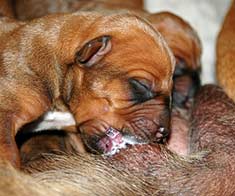
Dog Birth
HEALTHIn the third article of our dog pregnancy series, we look at the wonderful, but messy, process of bringing newborn puppies into the world.
Indoor Dog Potties
DOG PRODUCTSIt's been a long day at work. You were so busy, you didn't even take time to eat a sandwich, let alone run home to let your dog out. You're on your way home, knowing the poor dog is crossing his or her legs by now, when your car breaks down, delaying you even further. Can't somebody make this easier?
Your Dog’s Digestive System
PHYSIOLOGYEver wonder why your dog eats so fast? Or why he eats gross things? Or why he gets sick to his stomach? Or why his waste stinks so bad? Some of these things are normal, some are not.
Canine Respiratory System
BREATHINGThe basic function of your dog's respiratory system is to bring oxygen in to and remove carbon dioxide from the body. Knowing the symptoms of respiratory diseases can help you help your stay healthy.
Shelter Dog Adoption Tips for Success
ADOPTION Are you intimidated by the prospect of "rescuing" a dog from a shelter? One reason that you may be wary of adopting a dog from a shelter is not knowing how to choose. Adopting a dog from a shelter can be a rewarding process, if you're prepared to do a reasonable amount of research.
Canine Urinary Tract Infections
SYMPTOMS AND TREATMENTDoes your dog seem to be having trouble relieving his or her bladder? Learn how to recognize the signs of urinary tract infections and how to treat them before they spread.
What to do for Dog Diarrhea
SYMPTOMS AND REMEDIESIf you have dogs in your house for any length of time, you have likely experienced at least one bout of dog diarrhea. Beyond the pain in the tuckus involved in cleaning up the mess, you should know what causes diarrhea, and when it's important to see the vet.
What to do for a Dog Bite
DOG BEHAVIOR Getting bitten by a dog can be scary, and you may be tempted to run around in circles for a while, trying to figure out what to do. Here's our guide to help you manage the situation.
Top Ten Tips for Living with a Senior Dog
DOG HEALTH Bringing home a new puppy is so exciting, but it doesn’t take all that long for your exuberant puppy to grow into a senior dog who may have special needs. Here are the doggies.com top ten tips for taking care of your companion who has been with you through so much.