Australian Shepherd Breed Guide
Quick Quiz: Where did the Australian Shepherd originate? If you said Australia, surprisingly you'd be wrong!
History of the Aussie
During the Gold Rush in the Western United States in 1849, many people came to test their luck at getting rich quickly. With these people came their dogs, and often their livestock. Some of the groups that came were the Spanish Basque sheep herders and the Australians, who also brought sheep. It is thought that the Australian Shepherd developed as a cross-breed between the Spanish and Australian dogs used for herding.
These early Western settlers needed a dog who could keep the herd together, protect them from predators, and work on remote ranges under the hot desert conditions as well as in the cold, rough mountainous conditions. Although the dogs from Spain were well-suited to keeping the herd together, the Australian dogs were used to the terrain and weather conditions. Selectively breeding the two gave rise to a new dog with all of the qualities being sought: speed, athleticism, energy, endurance, intelligence, flexibility, independence, obedience, and the ability to handle severe weather.
In addition to performing their duties in the field, Australian Shepherds were popular in the 1950's as performing dogs in rodeos, horse shows, and in several Disney films, which is how the breed grew to become popular throughout the United States.
The Australian Shepherd Club of America was formed to promote the breed and set standards for breeding in 1957. The members of the club were more interested in the dog's performance than in its looks, and did not seek membership in the American Kennel Club.
However, some members felt that show conformance was important, and broke off from the ASCA to form the United States Australian Shepherd Association with its own breed standard. This group did seek membership in the AKC, with the first registration being in 1993, the 135th breed to be recognized.
The breed has subsequently been bred to smaller sized dogs, sometimes referred to as varieties of the original breed, although some think they should be entirely unique breeds. The Miniature version weighs between 17 and 35 pounds, standing 14 - 18 inches tall. The Toy version wighs just 12 - 15 pounds. All other characteristics of the smaller versions are the same as are seen in the full-sized breed.
Aussie Appearance
The full-sized Australian Shepherd is a medium-sized dog ranging in weight from 40 - 65 pounds. Males usually stand about 20 - 23 inches tall, while females are slightly shorter at 18 - 21 inches.
Depending on whether the dog was bred for field work or show, the animal will bear distinct differences. Show dogs have longer, fuller coats with more white coloring. The coat requires weekly brushing to detangle and condition the fur, as well as to remove dirt. In addition, show dogs have heavier bone structures than field dogs who must run all day long.
The coloring available for Aussies encompasses a wide range, including black, red (or liver), blue merle (black marbled with grey), and red merle (red marbled with buff or silver). In addition to these base colors, a dog may also have copper or white markings on the face, chest and legs. However, dogs with excessively white faces and ears are prone to sunburn and subsequent skin cancer problems. In addition, dogs with white ears are prone to a disease known as white-related deafness.
Because of the genetics involved in producing the distinctive merle coat associated with Aussies, it is a bad idea to breed two merle dogs. The combination results in a 25% likelihood that a puppy born to two merles will be all white with blue eyes. Although these dogs are beautiful, they are often deaf and blind.
Australian Shepherds were sometimes called "ghost-eye dogs" because their eye color is so variable. They may be any shade of brown or blue, or the dog may have one eye of each color. In some cases, especially in merle-coated dogs, a single eye may have one color swirled into another or may have one eye color on the left side of the iris and another on the right side of the same iris.
The tail length of the Aussie is also variable, although in countries where docking is allowed, the tails of working dogs are usually cut short to avoid injury in the field.
Activities for the Australian Shepherd
Although these dogs were originally bred solely to herd sheep, their high intelligence and endurance have led to their success at a variety of dog sports including agility, flyball, and Frisbee. They have also been trained in search and rescue, as well as for use as service and therapy dogs. Finally, they make great companion dogs for those who prefer to just enjoy a dog without making him or her work. With companion dogs, care should be taken to ensure that the dog is given enough exercise and mental stimulation to keep him happy.
These active dogs are very loyal and devoted, but can be a handful if not kept busy. If you don't provide a game, the dog will think of one himself. Their herding instinct is so strong that they will herd anything they come across including toys, small animals, and even children, nipping at their heels when it is time to go to bed. Herding also requires guarding the livestock, and these dogs will warn you when someone enters your property.
These dogs have a tendency to become destructive when they are bored, making a crate a very necessary accessory to contain the dog when you are away from home.
Are there health concerns with the Aussie?
Aussies live an average of 12 - 13 years, but they can be plagued by back and hip problems, bladder infections, and epilepsy.
Like many medium-to-large active dogs, hip dysplasia can be a problem in Australian Shepherds. Before breeding, both parents should be checked and certified by the Othopedic Foundation for Animals (OFA) as clear of any joint malformations which may be passed on genetically. In addition, careful breeders will have the dogs' eyes checked by a veterinarian certified by the Canine Eye Registration Foundation (CERF) to check for possible eye concerns.
Like their close relatives the Collie, Aussies may carry a gene that makes heartworm preventatives and other drugs toxic. Genetic testing can determine whether or not your dog carries the mutated multi-drug resistance (MDR1) gene, which indicates that the dog will not be able to clear certain drugs from his system, resulting in a build-up that eventually becomes toxic. Other drugs that may cause problems include loperamide which is prescribed for diarrhea relief and acepromazine which is sometimes used for anesthesia.
Even if you don't treat your dog with one of these medications, dogs may get a hefty dose if they eat the feces of treated animals. If your dog is prone to cleaning up after livestock or other pets, make sure you check the medications that these other animals are taking to prevent a problem in your Aussie.
Is the Aussie the right breed for my family?
Aussies are truly people oriented. They want to go everywhere and do everything with you. If you cannot devote a lot of time and energy to your dog, you should probably look for another breed. However, if you want a fun-loving dog that is easy to train and housebreak and excels at many different activities, the Aussie may be just what you are looking for. This dog is a medium-shedder, meaning that some loose hair falls out regularly through-out the year, without seasonal blows of the entire coat.

Doggies Den: Latest Articles
 Homemade Thanksgiving Treats for Your Dog
NUTRITION We all want to include our dogs in our holiday celebrations, but hopefully, you're aware that sharing table scraps with your dog isn't always the best idea.
 Keeping Your Dog Safe during the Summer Months
HEALTH Summer is coming on fast, so it’s time to plan how you will keep your dog safe and healthy through the lazy, carefree, warm days.
 Vaccination Time Again-Keeping Your Puppy Healthy
DOG HEALTH So you have your new puppy picked out. There are quite a few shots, treatments and examinations that will keep the newest member of your family healthy.
 Canine Thanksgiving Feast
NUTRITION With the wide variety of food at Thanksgiving dinner, chances are you'll want to give your dog something special, too. If you're contemplating what to feed your dog for the holiday, here is a guide to a great Canine Thanksgiving Feast.
 Dog Walking Tips Every Owner Should Know
DOG FUN Walking your dog is not only crucial to keeping him healthy and happy, it strengthens the bond between your canine friend and his caregiver. There are a lot of obstacles out there. Don’t forget these simple tips to keep your walk fun and safe in the outside world.
 The Benefits of Physiotherapy for your Dog
HEALTH The same techniques that physiotherapists use to treat a variety of injuries and conditions in humans have been adapted to suit animals with great success. Family pets, show dogs, and working dogs can all benefit greatly from physiotherapy. Dogs whose activities involve a lot of agility are especially susceptible to the types of problems that physiotherapy can address.
 The Decision- Adding a Dog to Your Family
FIRST TIME OWNERSBringing a dog into your family is a decision where many people don’t realize it’s magnitude until after they have the dog. There are a number of things that you need to research before you decide to purchase a dog, and it starts right in your own home.
 Bringing Your Dog Into Your New Baby's Life
HEALTH Many believe that a dog and a new baby cannot happily coexist, so therefore the dog has to go. This is not necessarily the case. A new baby does not mean you have to abandon your dog.

Doggies Den:
Most Popular Articles
Dog Pregnancy Symptoms
HEALTHIf you suspect your dog might be pregnant, check out part one in this series on pregnant dogs, where we cover pregnant dog symptoms.
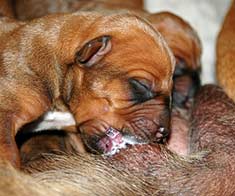
Dog Birth
HEALTHIn the third article of our dog pregnancy series, we look at the wonderful, but messy, process of bringing newborn puppies into the world.
Indoor Dog Potties
DOG PRODUCTSIt's been a long day at work. You were so busy, you didn't even take time to eat a sandwich, let alone run home to let your dog out. You're on your way home, knowing the poor dog is crossing his or her legs by now, when your car breaks down, delaying you even further. Can't somebody make this easier?
Your Dog’s Digestive System
PHYSIOLOGYEver wonder why your dog eats so fast? Or why he eats gross things? Or why he gets sick to his stomach? Or why his waste stinks so bad? Some of these things are normal, some are not.

Canine Respiratory System
BREATHINGThe basic function of your dog's respiratory system is to bring oxygen in to and remove carbon dioxide from the body. Knowing the symptoms of respiratory diseases can help you help your stay healthy.
Shelter Dog Adoption Tips for Success
ADOPTION Are you intimidated by the prospect of "rescuing" a dog from a shelter? One reason that you may be wary of adopting a dog from a shelter is not knowing how to choose. Adopting a dog from a shelter can be a rewarding process, if you're prepared to do a reasonable amount of research.
Canine Urinary Tract Infections
SYMPTOMS AND TREATMENTDoes your dog seem to be having trouble relieving his or her bladder? Learn how to recognize the signs of urinary tract infections and how to treat them before they spread.
What to do for Dog Diarrhea
SYMPTOMS AND REMEDIESIf you have dogs in your house for any length of time, you have likely experienced at least one bout of dog diarrhea. Beyond the pain in the tuckus involved in cleaning up the mess, you should know what causes diarrhea, and when it's important to see the vet.
What to do for a Dog Bite
DOG BEHAVIOR Getting bitten by a dog can be scary, and you may be tempted to run around in circles for a while, trying to figure out what to do. Here's our guide to help you manage the situation.
Top Ten Tips for Living with a Senior Dog
DOG HEALTH Bringing home a new puppy is so exciting, but it doesn’t take all that long for your exuberant puppy to grow into a senior dog who may have special needs. Here are the doggies.com top ten tips for taking care of your companion who has been with you through so much.