The Working Group
Exceedingly intelligent and loyal to a fault, the dogs of the working group were bred solely to assist people in such tasks as search and rescue, guarding home and hearth, and pulling supplies across the frozen tundra. They are generally large powerful dogs, and must be carefully trained and socialized if you plan on keeping them in your home.
Members of the Working Group
This group is comprised of twenty-six breeds, according to the American Kennel Club, although various international clubs define the group differently. And of course, any dog who carries out a task such as therapy or herding may be considered a working dog. For purposes of this article, however, we will discuss the AKC group.
In general, any dog bred for guarding, rescue, police work, or messenger work is considered a working dog. More specifically, the most commonly known members of the group are the Akita, the Alaskan Malamute, the Bernese Mountain Dog, the Boxer, the mastiff breeds, the Dobie, the Schnauzer (both Giant and Standard), the Great Dane, the Newfoundland, the Portuguese Water Dog, the Rottweiler, the St. Bernard, the Samoyed, and the Siberian Husky.
Although they all have jobs, the diversity of the jobs makes it important to look carefully at the individual breeds included in the group before making a selection as to which dog might be desired as a family pet. The dogs of the group can be roughly divided into those who guard, those who pull, and those who rescue. It's an important distinction, as those who pull and rescue are definitely not suited to guard work, even though you may feel that their large size is adequate to protect you and your home.
Guard Breeds
The dogs associated with guarding make up the largest proportion of the working dogs. They are the best at aggressively protecting the property and people they are tasked with guarding, but they may not always be the largest dog in the room. For example, the Boxer is a medium-sized dog who got his name because of his propensity for standing on his hind feet and batting at his foes.
The mastiff breeds (Mastiff, Bullmastiff, Neopolitan Mastiff, and Tibetan Mastiff) were all bred to guard property. Egyptian drawings as far back as 3000 BC show the large Mastiff as a fearless dog, fighting beside soldiers or lions or even gladiators. The Neopolitan Mastiff also had his origins in ancient times, where he was used as a fighter in the Roman Army. A native of the Himalayas, the Tibetan Mastiff would be turned loose at night to guard his family as they slept in their tents. The Bullmastiff, a mix of about 60% Mastiff and 40% Bulldog, was created in the mid-19th century to keep large estates free from poachers.
The Doberman Pinscher and Rottweiler are still used in much the same way they were originally intended. The Dobie, named for tax collector Louis Doberman, was bred in Germany around the year 1900 to serve as the tax man's guard dog and companion. The Rottweiler was also bred in Germany for his guarding, as well as herding, instincts. Properly trained, both dogs can be gentle family companions, although both are capable of extreme aggression when threatened.
Both the Standard and Giant Schnauzers were bred in Germany. The standard-sized dog came first and was used to guard farm families and their livestock, and to protect the family as they traveled to market to sell their produce and meat. The Giant Schnauzer helped German farmers drive livestock to market, and was also used in town to guard butcher shops and breweries. During World War I, the Giant Schnauzer was used in police training in Germany due to his high intelligence and capacity to learn quickly.
The Germans also gave us the Great Dane, a dog developed for his ability to hunt wild boar. When this activity became less necessary, these giant dogs became prized for their ability to guard large estates and provide companionship to the estate's owners.
Pulling Dogs
People in snowy climates are familiar with the necessity of having good sled dogs, or at least they were before the snowmobile was invented. The names of these pulling dogs indicate the part of the world from which they originated. The Alaskan Malamute, the Samoyed (from the Samoyedic area of Siberia), and the Siberian Husky were bred to pull freight through deep snow to provide food, wares, and medical supplies to people in outlying, snowbound villages. Their thick coats provide protection from cold and blinding snow, while their single-mindedness serves them well in continuing to pull regardless of bad weather or treacherous terrain.
These dogs are intensely loyal and may bond especially closely to one person in the family, although they are fun-loving and enjoy interacting with everyone from the mailman to the burglar who wants to clean out your home.
The Bernese Mountain Dog is also a great puller, but was bred to pull carts over dry land, as well as over snow. This heavy-coated dog was bred in Switzerland, where he was used to pull carts to market and drive dairy cattle. These dogs are also friendly to everyone, and generally do not make good guard dogs.
Rescue Dogs
The Newfoundland and the Portuguese Water Dog are the breeds most closely associated with water rescue, while the Saint Bernard has historically been involved in mountain rescue work.
The Newfoundland is the larger of the two water dogs. He originated in Newfoundland (imagine that!) where the breed was used to pull nets for fisherman. He is also a worker on land and was historically used for hauling wood from the forest to the farm and for work in the blacksmith's shop, providing power to the large bellows that kept the fire going.
The PWD, bred in Portugal, was also used to retrieve nets for fishermen. The breed's other jobs included diving for fish and carrying messages between boats, Most of these jobs are now unnecessary due to advancing technology, but the dog is still popular as a companion to sailors the world over.
The massive Saint Bernard was originally used in the mountain area between Switzerland and Italy to find and rescue travelers lost in the snow. And the cask of brandy the dog carried around his neck wasn't a bad greeting for the people he rescued.
Barry, one of the original Saint Bernards working the Great St. Bernard Pass in the late 18th century, is said to have saved between 40 and 100 lives. The original Saint Bernards were almost rendered extinct by avalanches in the early 1800's, but breeding of the remaining dogs with the Newfoundland in the 1850's brought the breed back. These new dogs are not suited to mountain work because their long fur traps water, allowing the snow to freeze in their coats which weighs them down.
All three of these dogs are outgoing and friendly, being able to gain the trust of those they are sent to rescue. They do have a high degree of loyalty to their families, and may be used as watch dogs, but they are not generally aggressive enough to be guard dogs.
Characteristics of the Working Group Dogs
The first thing you will notice about the dogs in this group is their large size. The smallest of the working group breeds are the Siberian Husky and the Standard Schnauzer, both of which weigh upwards of 40 pounds when full-grown. Many of these dogs look larger than they actually are because they have thick coats suitable for working outside in all kinds of weather; however, the largest dogs in the group may top 200 pounds.
These dogs are also known for bravery and loyalty. A dog who has been bred and trained to work will never be happier than when doing his or her assigned task. So happy, in fact, that it will be tough to break the dog away from that task. For example, it is not unheard of for a water rescue dog to drown from exhaustion because he simply won't give up looking for the person he was sent to rescue.
The intelligence of these dogs is legendary, making them some of the easiest dogs to train. Because they have important jobs, these dogs have to be capable of absorbing their lessons quickly so they can be of service. Consider the Portuguese Water Dog, recently adopted by President Obama and his family. These dogs were bred for water rescue, but they wouldn't be much good to anyone if they weren't smart enough or well-trained enough to come back to the boat or to shore after making a rescue.
Similarly, a Doberman Pinscher must be able to distinguish friend from foe, a Siberian Husky must be able to follow mushing commands without fail, and the Saint Bernard must be able to find lost travelers in the snow and then find his way back to safety.
Should I get a working dog?
If you intend to keep one of these dogs as a family pet, it is essential you train early and train often. Their sheer size and strength make them dangerous to members of your family, even if they are not intending to be vicious. Before your dog grows to an unmanageable size, you must make sure the dog understands that all four feet belong on the floor, that food on the counter is generally for the people in the house, and that dogs must sit and stay when they are told to do so.
Socialization is also important. Your dog must be able to play well with others, whether they be four-legged or two-legged. A dog of this size can easily hurt a small house pet or a toddler just by being exuberant. As puppies, working group dogs must be exposed to a variety of people and situations to prevent a dangerous panicked flight when they encounter scary things after they have achieved their full size.

Doggies Den: Latest Articles
 Homemade Thanksgiving Treats for Your Dog
NUTRITION We all want to include our dogs in our holiday celebrations, but hopefully, you're aware that sharing table scraps with your dog isn't always the best idea.
 Keeping Your Dog Safe during the Summer Months
HEALTH Summer is coming on fast, so it’s time to plan how you will keep your dog safe and healthy through the lazy, carefree, warm days.
 Vaccination Time Again-Keeping Your Puppy Healthy
DOG HEALTH So you have your new puppy picked out. There are quite a few shots, treatments and examinations that will keep the newest member of your family healthy.
 Canine Thanksgiving Feast
NUTRITION With the wide variety of food at Thanksgiving dinner, chances are you'll want to give your dog something special, too. If you're contemplating what to feed your dog for the holiday, here is a guide to a great Canine Thanksgiving Feast.
 Dog Walking Tips Every Owner Should Know
DOG FUN Walking your dog is not only crucial to keeping him healthy and happy, it strengthens the bond between your canine friend and his caregiver. There are a lot of obstacles out there. Don’t forget these simple tips to keep your walk fun and safe in the outside world.
 The Benefits of Physiotherapy for your Dog
HEALTH The same techniques that physiotherapists use to treat a variety of injuries and conditions in humans have been adapted to suit animals with great success. Family pets, show dogs, and working dogs can all benefit greatly from physiotherapy. Dogs whose activities involve a lot of agility are especially susceptible to the types of problems that physiotherapy can address.
 The Decision- Adding a Dog to Your Family
FIRST TIME OWNERSBringing a dog into your family is a decision where many people don’t realize it’s magnitude until after they have the dog. There are a number of things that you need to research before you decide to purchase a dog, and it starts right in your own home.
 Bringing Your Dog Into Your New Baby's Life
HEALTH Many believe that a dog and a new baby cannot happily coexist, so therefore the dog has to go. This is not necessarily the case. A new baby does not mean you have to abandon your dog.
Doggies Den:
Most Popular Articles
Dog Pregnancy Symptoms
HEALTHIf you suspect your dog might be pregnant, check out part one in this series on pregnant dogs, where we cover pregnant dog symptoms.
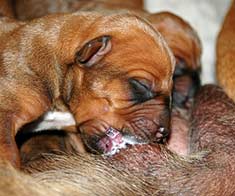
Dog Birth
HEALTHIn the third article of our dog pregnancy series, we look at the wonderful, but messy, process of bringing newborn puppies into the world.
Indoor Dog Potties
DOG PRODUCTSIt's been a long day at work. You were so busy, you didn't even take time to eat a sandwich, let alone run home to let your dog out. You're on your way home, knowing the poor dog is crossing his or her legs by now, when your car breaks down, delaying you even further. Can't somebody make this easier?
Your Dog’s Digestive System
PHYSIOLOGYEver wonder why your dog eats so fast? Or why he eats gross things? Or why he gets sick to his stomach? Or why his waste stinks so bad? Some of these things are normal, some are not.
Canine Respiratory System
BREATHINGThe basic function of your dog's respiratory system is to bring oxygen in to and remove carbon dioxide from the body. Knowing the symptoms of respiratory diseases can help you help your stay healthy.
Shelter Dog Adoption Tips for Success
ADOPTION Are you intimidated by the prospect of "rescuing" a dog from a shelter? One reason that you may be wary of adopting a dog from a shelter is not knowing how to choose. Adopting a dog from a shelter can be a rewarding process, if you're prepared to do a reasonable amount of research.
Canine Urinary Tract Infections
SYMPTOMS AND TREATMENTDoes your dog seem to be having trouble relieving his or her bladder? Learn how to recognize the signs of urinary tract infections and how to treat them before they spread.
What to do for Dog Diarrhea
SYMPTOMS AND REMEDIESIf you have dogs in your house for any length of time, you have likely experienced at least one bout of dog diarrhea. Beyond the pain in the tuckus involved in cleaning up the mess, you should know what causes diarrhea, and when it's important to see the vet.
What to do for a Dog Bite
DOG BEHAVIOR Getting bitten by a dog can be scary, and you may be tempted to run around in circles for a while, trying to figure out what to do. Here's our guide to help you manage the situation.
Top Ten Tips for Living with a Senior Dog
DOG HEALTH Bringing home a new puppy is so exciting, but it doesn’t take all that long for your exuberant puppy to grow into a senior dog who may have special needs. Here are the doggies.com top ten tips for taking care of your companion who has been with you through so much.