Chow Chow Breed Guide
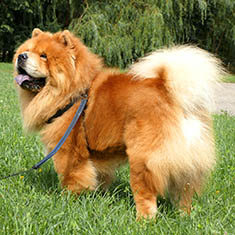
This beautiful entry in the non-sporting group carries the Chinese name songshi quan, which translates as “puffy lion dog”. It’s easy to see where that name comes from. The Chow’s coat is very dense and is particularly thick around the neck, making it look a bit like a lion’s mane.
The Chow is sometimes thought to be the original ancestor of the Samoyed, Norwegian Elkhound, Pomeranian, and Keeshond, all of whom carry the distinctive long-furred tail that lays curled up over the dog’s back.
Breed Standard
The official breed standard from the American Kennel Club calls for a medium-sized dog with a powerful and sturdy body, strong muscular development, and heavy bone structure. The large head has a broad, flat skull and short, broad muzzle accentuated by a ruff. The tongue is blue-black, the expression is scowling, and the gait is stilted. The standard goes on to say that “the Chow is a masterpiece of beauty, dignity, and naturalness.”
The Chow stands 17 – 20 inches at the shoulders, and the dog should be square when seen in profile, with the distance from the forechest to the point of the buttocks equal to the height at the withers. The average weight of a Chow Chow is 45 – 70 pounds.
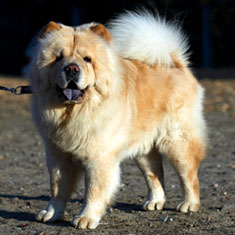
There are two coat varieties: rough and smooth, although both are double-layered. On a smooth coated dog, there is no ruff, and the outer coat is hard and dense. On the rough coated dog, the outer coat is more abundant and off-standing. In both cases, the undercoat is soft, thick, and woolly.
Five colors are acceptable: red, black, blue, cinnamon, and cream. Reds vary from light golden to deep mahogany, while cinnamon ranges from light fawn to deep cinnamon. Blue results from a dilution of the black gene, while cinnamon is a dilution of red. Cream-colored chows typically cannot be shown because their pink to flesh-colored noses do not conform to the breed standard of a black nose.
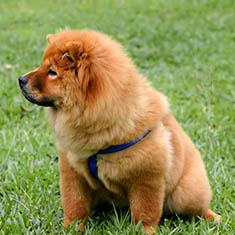
Buyer beware: When choosing a puppy, remember that the color of the adult dog’s fur may be different than the puppy’s. Also, you may have a tough time choosing just one of these puppies because they resemble little teddy bears as puppies. Just remember they’re all going to chew your shoes and grow into full-sized dogs!
Grooming
With all of that fur, the Chow, as you might imagine, requires some careful grooming. A rake brush and a pin brush should be used at least twice a week to keep the dog’s coat in good shape. The rake helps to remove any dead undercoat fur while the pin brush is used to keep the top coat shining and healthy. It’s important that you make sure to brush all the way down to the skin to prevent matting of the fur close to the body. Coat dressing such as mink oil spray can be applied to the fur to make brushing easier. Too much grooming of the ruff can strip it away, so care must be taken when grooming around the neck.
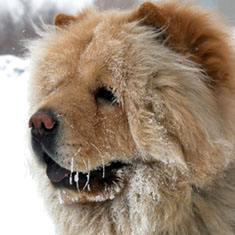
The double coat of a Chow Chow is designed not only to keep him warm in the winter but also to trap cool air in the summer. Regular grooming will remove dirt and debris packed into the fur which may prevent air circulation that is important to keeping the dog cool. If you keep up with the brushing, there is no need to shave the dog to keep him cool. In fact, shaving off the protective fur can be worse than leaving it in place.
Like several other breeds, Chows are prone to the development of hot spots. They can appear in a heartbeat, and grow very quickly into huge, oozing sores. These spots are very itchy, and the more the dog scratches at them, the more painful they become. Hot spots can be the result of flea or insect bites, shampoo that isn’t thoroughly rinsed out, allergies, or hormone disorders. Your vet can give you an ointment to relieve the itch, or maybe even a steroid shot for severe cases. You may also need to restrain the dog to keep him from scratching and biting at the spot until it heals.
Like all double-coated dogs, Chows will “blow” their coats in the spring and fall, requiring more frequent brushing to deal with the deluge of shedding.
Temperament
This alert dog is only moderately active and does not do well in excessively hot weather. A casual stroll in the cool of the morning or evening will meet his exercise needs, particularly in the summertime.
Chow Chows were originally bred to hunt, herd, pull sleds, and guard the home, but are now most often kept as companion pets. They quickly become one-person dogs, fiercely protective of those they see as their family. Some insurance companies view them as high-risk because of their protective nature, although empirical studies of breeds involved in dog bite fatalities do not bear out the level of concern.
Chow Chows are very stubborn and somewhat resistant to training. It is much easier to get training and socialization done during puppyhood while they are more malleable. Failure to train your Chow as a puppy will result in a grown Chow who has no respect for you and refuses to accept your authority. The Chow Chow Fanciers of America have a very good primer on socialization of Chow puppies.
Chows are generally well-behaved, non-destructive, and quiet. Somewhat aloof and independent, they are often compared to cats. This aloofness, combined with their protective instincts, means that they won’t greet all your friends with enthusiasm. They may also not care to be involved with other dogs, particularly those of the same gender.
They can also be playful. Watch the video below to see a Chow Chow in action, dancing to try to entice his toy stick to play with him:
Health Issues
Chow Chows are susceptible to a number of health problems, the most common being hip dysplasia (a crippling deformity of the hip sockets) and entropion (a turning in of the eyelids that can cause blindness if untreated). Ask your breeder to show you an OFA certificate for both parents, showing them to be free of dysplasia, and ask for a guarantee against dysplastic hips for two years before you hand over your hard-earned money for a puppy.
Entropion may be inherited or the result of an eye injury. When purchasing a puppy, look for the parents to have clear, dry eyes. Any crustiness or inflammation in your dog should be evaluated by a veterinarian immediately to prevent future blindness.
Because of their short muzzles, Chows often have trouble with anesthesia and should be put under only with someone experienced with brachycephalic breeds.
As mentioned earlier, Chows have trouble in high heat, particularly on humid days. If your dog is panting heavily with raspy breath sounds, it is an emergency. Wet the dog with cold water and wrap him in towels soaked with cold water. Place ice packs around him and transport him immediately to the nearest veterinary clinic.
Would a Chow Chow fit into your home?
Overall, these dogs are good for families that don’t anticipate providing a lot of physical activity, but the family must have time to do the early training and socialization required to prevent problems later. The family must also be willing to put up with excessive seasonal shedding and the associated grooming.
People who would live with a Chow must be able to provide cooler conditions in the summertime and must investigate the insurance implications of having a breed some consider aggressive.
Properly trained and socialized, these dogs do well in homes with no other dogs and with people who respect their dignity and independence.

Doggies Den: Latest Articles
 Homemade Thanksgiving Treats for Your Dog
NUTRITION We all want to include our dogs in our holiday celebrations, but hopefully, you're aware that sharing table scraps with your dog isn't always the best idea.
 Keeping Your Dog Safe during the Summer Months
HEALTH Summer is coming on fast, so it’s time to plan how you will keep your dog safe and healthy through the lazy, carefree, warm days.
 Vaccination Time Again-Keeping Your Puppy Healthy
DOG HEALTH So you have your new puppy picked out. There are quite a few shots, treatments and examinations that will keep the newest member of your family healthy.
 Canine Thanksgiving Feast
NUTRITION With the wide variety of food at Thanksgiving dinner, chances are you'll want to give your dog something special, too. If you're contemplating what to feed your dog for the holiday, here is a guide to a great Canine Thanksgiving Feast.
 Dog Walking Tips Every Owner Should Know
DOG FUN Walking your dog is not only crucial to keeping him healthy and happy, it strengthens the bond between your canine friend and his caregiver. There are a lot of obstacles out there. Don’t forget these simple tips to keep your walk fun and safe in the outside world.
 The Benefits of Physiotherapy for your Dog
HEALTH The same techniques that physiotherapists use to treat a variety of injuries and conditions in humans have been adapted to suit animals with great success. Family pets, show dogs, and working dogs can all benefit greatly from physiotherapy. Dogs whose activities involve a lot of agility are especially susceptible to the types of problems that physiotherapy can address.
 The Decision- Adding a Dog to Your Family
FIRST TIME OWNERSBringing a dog into your family is a decision where many people don’t realize it’s magnitude until after they have the dog. There are a number of things that you need to research before you decide to purchase a dog, and it starts right in your own home.
 Bringing Your Dog Into Your New Baby's Life
HEALTH Many believe that a dog and a new baby cannot happily coexist, so therefore the dog has to go. This is not necessarily the case.  A new baby does not mean you have to abandon your dog.

Doggies Den:
Most Popular Articles
Dog Pregnancy Symptoms
HEALTHIf you suspect your dog might be pregnant, check out part one in this series on pregnant dogs, where we cover pregnant dog symptoms.
Dog Birth
HEALTHIn the third article of our dog pregnancy series, we look at the wonderful, but messy, process of bringing newborn puppies into the world.
Indoor Dog Potties
DOG PRODUCTSIt's been a long day at work. You were so busy, you didn't even take time to eat a sandwich, let alone run home to let your dog out. You're on your way home, knowing the poor dog is crossing his or her legs by now, when your car breaks down, delaying you even further. Can't somebody make this easier?
Your Dog’s Digestive System
PHYSIOLOGYEver wonder why your dog eats so fast? Or why he eats gross things? Or why he gets sick to his stomach? Or why his waste stinks so bad? Some of these things are normal, some are not.
Canine Respiratory System
BREATHINGThe basic function of your dog's respiratory system is to bring oxygen in to and remove carbon dioxide from the body. Knowing the symptoms of respiratory diseases can help you help your stay healthy.
Shelter Dog Adoption Tips for Success
ADOPTION Are you intimidated by the prospect of "rescuing" a dog from a shelter? One reason that you may be wary of adopting a dog from a shelter is not knowing how to choose. Adopting a dog from a shelter can be a rewarding process, if you're prepared to do a reasonable amount of research.
Canine Urinary Tract Infections
SYMPTOMS AND TREATMENTDoes your dog seem to be having trouble relieving his or her bladder? Learn how to recognize the signs of urinary tract infections and how to treat them before they spread.
What to do for Dog Diarrhea
SYMPTOMS AND REMEDIESIf you have dogs in your house for any length of time, you have likely experienced at least one bout of dog diarrhea. Beyond the pain in the tuckus involved in cleaning up the mess, you should know what causes diarrhea, and when it's important to see the vet.
What to do for a Dog Bite
DOG BEHAVIOR Getting bitten by a dog can be scary, and you may be tempted to run around in circles for a while, trying to figure out what to do. Here's our guide to help you manage the situation.
Top Ten Tips for Living with a Senior Dog
DOG HEALTH Bringing home a new puppy is so exciting, but it doesn’t take all that long for your exuberant puppy to grow into a senior dog who may have special needs. Here are the doggies.com top ten tips for taking care of your companion who has been with you through so much.