Flat-Coated Retriever Breed Guide
At first glance, you may believe you are looking at a black Golden Retriever when you see a Flat-Coated Retriever, but they are distinct and separate breeds. The Flat-Coated Retriever was bred in the United Kingdom as a gundog for both land and water retrieval of prey. Dog historians believe that Newfoundlands, Collies, and Setters were carefully bred together to produce this new breed in the mid- to late-19th century. The breed was very popular, until it was used to help create the Golden Retriever, which soon eclipsed it in popularity.
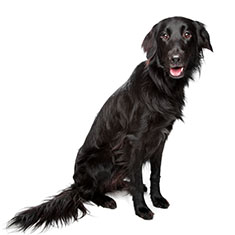
Flat-Coated Retriever Appearance
According to the American Kennel Club’s breed standard, the Flat-Coated Retriever should be 22 – 24.5 inches tall at the shoulder and should weigh between 45 and 75 pounds. This makes them lighter than most other retriever breeds, and they have what is described as a more elegant appearance.
The dog’s coat is moderately long, with a slight waviness along the back. Occasional grooming with a good brush is all that is required to keep the coat in good shape. The coat is always solid-colored, either in liver or in black. Some Flat-Coats are yellow, but this is a disqualifying fault in the conformation ring.
The long, feathered tail never stops wagging, a reflection of the dog’s desire to play and his love for his family.
The medium-sized almond-shaped eyes are widely set and must be dark brown or hazel. The nose is black on black dogs and brown on liver-colored dogs. The small ears lie close to the head, but are higher set on the skull than in a hound. The dog’s expression should be alert, intelligent, and kind.
Temperament of the Flat-Coated Retriever
The Flat-Coat makes both a wonderful family companion and an excellent hunting dog on both land and water. The wonderful sense of smell Flat-Coats inherited from their setter ancestors has been put to use in the drug-detection arena, as well.
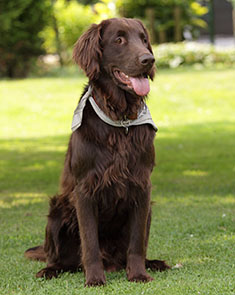
Because of their natural abundant energy, Flat-Coats who are not used in the field must have an opportunity for regular exercise. They also enjoy a good mental challenge to keep their intelligent minds occupied and to prevent destructive behaviors. Competing in obedience, agility, and field hunting trials can provide the necessary mental stimulation.
While the Flat-Coat can make a nice watchdog by barking at strangers, he is not meant to be a guard dog and will not aggressively protect hearth and home.
Often called the Peter Pan of the dog world, the Flat-Coated Retriever takes a long time to graduate from puppyhood. Expect to deal with their youthful exuberance for at least three to five years. Fortunately, these dogs are intelligent and very quick to learn, so you can train them in obedience to help keep their enthusiasm from spilling over into bad behavior.
Flat-Coats are very people-oriented and think of themselves as part of the family. This is not a dog you will leave in an outside kennel and ignore until it’s hunting season. Rather, this is the dog that will follow you from room to room as you go about your daily business, often picking up a tennis ball or another toy in hopes that you have time to play.
Flat-Coat Health Issues
Although they are generally healthy, Flat-Coated Retrievers do have a higher risk of cancer than many other breeds. Some of the most concerning are hemangiosarcoma, fibrosarcoma, osteosarcoma, and malignant histiocytosis. The average lifespan of these dogs is just 8 – 10 years, with the most common cause of death being cancer.
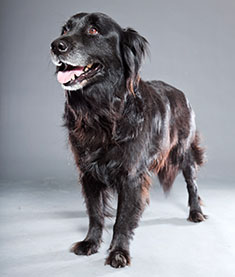
Hemangiosarcoma, which originates in the blood vessels, is extremely aggressive and spreads rapidly throughout the dog’s body. The cause is unknown, and the disease is generally fatal within one to three months of diagnosis.
Fibrosarcomas occur in the connective tissue beneath the dog’s skin. They grow slowly and can often be successfully removed surgically, although reoccurrence is common. They may ulcerate through the skin, causing a secondary infection.
Osteosarcoma is the most common type of bone tumor in dogs, normally affecting the legs. Treatment generally involves amputation of the diseased limb and chemotherapy to treat metastases, which are common. With aggressive treatment, a dog may survive one to two years after the initial diagnosis.
Malignant histiocytosis is a disease of the white blood cells, which is often fatal within two to four months. It does not respond well to either chemotherapy or radiation. There are several different types of histiocytosis in dogs, and an accurate diagnosis is often difficult. Be sure your vet can differentiate between the types that are fatal and the types that will respond well to treatment before making any decisions about your dog’s future.
Before purchasing a Flat-Coat puppy, ask your breeder to show you the results of tests done on their breeding stock for hip dysplasia and progressive retinal atrophy. The Orthopedic Foundation of America and the PennHIP program will certify a dog as free from hip dysplasia, and the Canine Eye Registration Foundation maintains a database of dogs found free from inherited eye disease.
Is a Flat-Coated Retriever the right dog for you?
If you’re looking for an intelligent, medium-sized, enthusiastic dog with lots of energy to spare, the Flat-Coated Retriever may be just what you’re looking for. However, if you cannot commit to giving your dog a lot of exercise for both his mind and his body, you’d be better off to look at other breeds. Grooming requirements are minimal, and the dog is reasonably healthy, although somewhat short-lived with an average lifespan of just 8 – 10 years.

Doggies Den: Latest Articles
 Homemade Thanksgiving Treats for Your Dog
NUTRITION We all want to include our dogs in our holiday celebrations, but hopefully, you're aware that sharing table scraps with your dog isn't always the best idea.
 Keeping Your Dog Safe during the Summer Months
HEALTH Summer is coming on fast, so it’s time to plan how you will keep your dog safe and healthy through the lazy, carefree, warm days.
 Vaccination Time Again-Keeping Your Puppy Healthy
DOG HEALTH So you have your new puppy picked out. There are quite a few shots, treatments and examinations that will keep the newest member of your family healthy.
 Canine Thanksgiving Feast
NUTRITION With the wide variety of food at Thanksgiving dinner, chances are you'll want to give your dog something special, too. If you're contemplating what to feed your dog for the holiday, here is a guide to a great Canine Thanksgiving Feast.
 Dog Walking Tips Every Owner Should Know
DOG FUN Walking your dog is not only crucial to keeping him healthy and happy, it strengthens the bond between your canine friend and his caregiver. There are a lot of obstacles out there. Don’t forget these simple tips to keep your walk fun and safe in the outside world.
 The Benefits of Physiotherapy for your Dog
HEALTH The same techniques that physiotherapists use to treat a variety of injuries and conditions in humans have been adapted to suit animals with great success. Family pets, show dogs, and working dogs can all benefit greatly from physiotherapy. Dogs whose activities involve a lot of agility are especially susceptible to the types of problems that physiotherapy can address.
 The Decision- Adding a Dog to Your Family
FIRST TIME OWNERSBringing a dog into your family is a decision where many people don’t realize it’s magnitude until after they have the dog. There are a number of things that you need to research before you decide to purchase a dog, and it starts right in your own home.
 Bringing Your Dog Into Your New Baby's Life
HEALTH Many believe that a dog and a new baby cannot happily coexist, so therefore the dog has to go. This is not necessarily the case.  A new baby does not mean you have to abandon your dog.

Doggies Den:
Most Popular Articles

Dog Pregnancy Symptoms
HEALTHIf you suspect your dog might be pregnant, check out part one in this series on pregnant dogs, where we cover pregnant dog symptoms.
Dog Birth
HEALTHIn the third article of our dog pregnancy series, we look at the wonderful, but messy, process of bringing newborn puppies into the world.

Indoor Dog Potties
DOG PRODUCTSIt's been a long day at work. You were so busy, you didn't even take time to eat a sandwich, let alone run home to let your dog out. You're on your way home, knowing the poor dog is crossing his or her legs by now, when your car breaks down, delaying you even further. Can't somebody make this easier?
Your Dog’s Digestive System
PHYSIOLOGYEver wonder why your dog eats so fast? Or why he eats gross things? Or why he gets sick to his stomach? Or why his waste stinks so bad? Some of these things are normal, some are not.

Canine Respiratory System
BREATHINGThe basic function of your dog's respiratory system is to bring oxygen in to and remove carbon dioxide from the body. Knowing the symptoms of respiratory diseases can help you help your stay healthy.
Shelter Dog Adoption Tips for Success
ADOPTION Are you intimidated by the prospect of "rescuing" a dog from a shelter? One reason that you may be wary of adopting a dog from a shelter is not knowing how to choose. Adopting a dog from a shelter can be a rewarding process, if you're prepared to do a reasonable amount of research.
Canine Urinary Tract Infections
SYMPTOMS AND TREATMENTDoes your dog seem to be having trouble relieving his or her bladder? Learn how to recognize the signs of urinary tract infections and how to treat them before they spread.
What to do for Dog Diarrhea
SYMPTOMS AND REMEDIESIf you have dogs in your house for any length of time, you have likely experienced at least one bout of dog diarrhea. Beyond the pain in the tuckus involved in cleaning up the mess, you should know what causes diarrhea, and when it's important to see the vet.
What to do for a Dog Bite
DOG BEHAVIOR Getting bitten by a dog can be scary, and you may be tempted to run around in circles for a while, trying to figure out what to do. Here's our guide to help you manage the situation.
Top Ten Tips for Living with a Senior Dog
DOG HEALTH Bringing home a new puppy is so exciting, but it doesn’t take all that long for your exuberant puppy to grow into a senior dog who may have special needs. Here are the doggies.com top ten tips for taking care of your companion who has been with you through so much.