Gordon Setter In-Depth
The beautiful Gordon Setter is a large dog used primarily in bird hunting. This breed is closely related to the more well-known Irish Setter and English Setter and is classed in the Sporting Group for AKC conformance shows.
The setters are pointing dogs, meaning that they alert the hunter to the presence and location of a gamebird on the ground. The bird must be of a type that will avoid its predators by hiding rather than by taking off in flight. Such birds include quail, guinea fowl, pheasant, and many types of grouse.
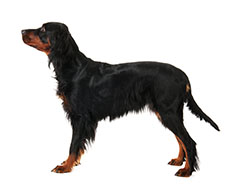
What does a Gordon Setter look like?
According to the American Kennel Club’s breed standard, the Gordon should have a coal black coat with chestnut or mahogany coloring on the paws, lower legs, throat, and muzzle. In addition, the dogs may have chestnut or mahogany “eyebrows”, small spots of color above each eye. The wavy coat is long and silky, but never curly. A coat of any color other than predominantly black is considered a disqualification in the show ring, but red, tan, or buff dogs do occur in nature. A white spot, the smaller the better, is permitted on the chest.
The Gordon is the heaviest of the setter breeds, with a weight of up to 80 pounds not uncommon in a male. At the shoulders, or withers, a Gordon should measure about 27 inches.
The overall appearance should be one of intelligence, nobility, and dignity, with no signs of being shy or vicious. This dog is built for strength and stamina more than for speed. The head is carried high, and the dog’s movements should be smooth and free.
Oval eyes are dark brown and bright, while the large, furry ears are set low on the head, approximately on line with the eyes.
Temperament of the Gordon Setter
The Gordon Setter is a confident dog, intelligent enough to train fairly easily, and strong-minded enough to think for himself in the field. They make good family dogs in that they are loyal and affectionate. They do well with children because of their patience. If antagonized by a child, the Gordon is more likely to walk away than to growl or snap.
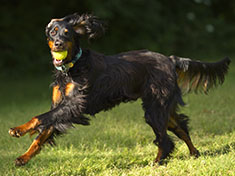
These dogs are slow to grow out of puppyhood, sometimes requiring as long as three or more years to get through their “annoying years.” Socialization and obedience training are essential to keep the dog from destroying your entire home. And don’t even think about banishing a Gordon to the garage or outdoor kennel. This dog is part of the family and wants to share both hearth and home.
Gordon Setters were bred to run. When working, a dog may cover as much as 50 miles each day. You must provide at least an hour a day of intense physical exercise to adult Gordons. Dogs younger than 18 months will need exercise, but should not be over-worked until their bones and joints are fully developed. After 18 months of age, a non-hunting Gordon could be trained for agility contests, which will satisfy both his mental and physical needs.
Gordons cannot be left outside unsupervised because their hunting instincts will take over, leading them into traffic or other dangerous situations. A setter following the scent trail of prey is not easily distracted by such mundane ideas as property borders and house rules.
Gordons love to talk, using different tones of voice to express different needs and emotions. When you have lived with your Gordon for awhile, you will recognize distinct greeting, warning, hunger, and thirst vocalizations.
Grooming Requirements
The coat of a Gordon Setter is relatively long, and as such requires a moderate amount of grooming. The coat must be brushed out at least weekly, more often after romps in the woods.
Wahl Pets, makers of dog grooming products, recommends that you “brush the coat at least twice a week with a metal rake and a bristle brush to remove mats and tangles, paying special attention to the feathering and the long hair on the chest, which can tangle easily.”
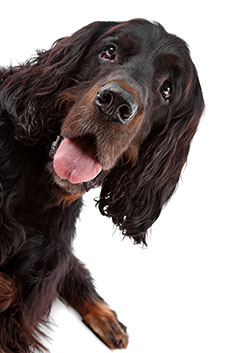
The feet are of special concern. Trimming the nails, as well as the hair on the bottom of the feet and between the toes is required to keep the feet from breaking down.
Last but not least, the ears must be kept clean and free of debris and moisture to prevent infections.
History of the Gordon Setter
Alexander Gordon, 4th Duke of Gordon was the person most responsible for developing the current breed characteristics in the early 1800’s, although there have been black and tan setters in Scotland and England as far back as the 16th century. Setters in general are thought to have derived from land spaniels, probably crossed with hounds or pointers.
Gordon Setters Rake and Rachel left Gordon Castle in 1842 to cross the pond and establish the breed in North America, where the AKC officially added Gordons to their stud book in 1892.
Gordon Setter Health Issues
Although generally healthy, Gordon Setters are prone to a few diseases, both genetic and opportunistic. The average lifespan of the Gordon is about 10 years.
As many as 50% of Gordons are carriers of the gene mutation that causes progressive retinal atrophy, a disease that leads to blindness. A DNA test is available, and all Gordons meant for breeding should be tested before being matched to a prospective mate. The trait is recessive, meaning that both parents must carry the mutation in order to produce a puppy with progressive retinal atrophy. Cataracts may also affect the eyes of a Gordon, requiring surgery to correct.
Hip dysplasia is slightly less prevalent in Gordon Setters than in other large breeds, but has been known to happen. Breeding stock should be certified free from the disease by either the PennHIP organization or the Orthopedic Foundation for Animals (OFA).
Before you sign a contract to buy a Gordon Setter, ask your breeder to show you his or her records of genetic testing. Both of the parents should, ideally, be free from the mutated gene that causes progressive retinal atrophy, and both should definitely be free from hip dysplasia. Good breeders will be happy to show you their records; it establishes them as knowledgeable breeders who selectively breed out undesirable traits.
The other disease you need to be aware of with Gordon Setters is gastric torsion, more commonly known as bloat. When a large dog eats too quickly or too soon after vigorous exercise the stomach can become twisted on itself. This is a veterinary emergency. To prevent death, your dog must be treated immediately, if not sooner, so make sure you know where the closest 24-hour emergency vet clinic is located.
Hypothyroidism is a fairly common condition affecting Gordon Setters. It is diagnosed by two blood tests, a thyroid stimulating hormone response test and a standard T4 test. The treatment involves supplying synthetic thyroid hormone to the dog for the rest of his or her life.
Is the Gordon Setter the dog for me?
If you are able and willing to provide vigorous exercise, proper training, moderate grooming, and a loving home, the Gordon Setter may be just what you’re looking for. However, if you are looking for a dog to be happy outside alone, or to be a couch potato while you watch TV, you might want to look at other breeds.

Doggies Den: Latest Articles
 Homemade Thanksgiving Treats for Your Dog
NUTRITION We all want to include our dogs in our holiday celebrations, but hopefully, you're aware that sharing table scraps with your dog isn't always the best idea.
 Keeping Your Dog Safe during the Summer Months
HEALTH Summer is coming on fast, so it’s time to plan how you will keep your dog safe and healthy through the lazy, carefree, warm days.
 Vaccination Time Again-Keeping Your Puppy Healthy
DOG HEALTH So you have your new puppy picked out. There are quite a few shots, treatments and examinations that will keep the newest member of your family healthy.
 Canine Thanksgiving Feast
NUTRITION With the wide variety of food at Thanksgiving dinner, chances are you'll want to give your dog something special, too. If you're contemplating what to feed your dog for the holiday, here is a guide to a great Canine Thanksgiving Feast.
 Dog Walking Tips Every Owner Should Know
DOG FUN Walking your dog is not only crucial to keeping him healthy and happy, it strengthens the bond between your canine friend and his caregiver. There are a lot of obstacles out there. Don’t forget these simple tips to keep your walk fun and safe in the outside world.
 The Benefits of Physiotherapy for your Dog
HEALTH The same techniques that physiotherapists use to treat a variety of injuries and conditions in humans have been adapted to suit animals with great success. Family pets, show dogs, and working dogs can all benefit greatly from physiotherapy. Dogs whose activities involve a lot of agility are especially susceptible to the types of problems that physiotherapy can address.
 The Decision- Adding a Dog to Your Family
FIRST TIME OWNERSBringing a dog into your family is a decision where many people don’t realize it’s magnitude until after they have the dog. There are a number of things that you need to research before you decide to purchase a dog, and it starts right in your own home.
 Bringing Your Dog Into Your New Baby's Life
HEALTH Many believe that a dog and a new baby cannot happily coexist, so therefore the dog has to go. This is not necessarily the case.  A new baby does not mean you have to abandon your dog.

Doggies Den:
Most Popular Articles
Dog Pregnancy Symptoms
HEALTHIf you suspect your dog might be pregnant, check out part one in this series on pregnant dogs, where we cover pregnant dog symptoms.
Dog Birth
HEALTHIn the third article of our dog pregnancy series, we look at the wonderful, but messy, process of bringing newborn puppies into the world.
Indoor Dog Potties
DOG PRODUCTSIt's been a long day at work. You were so busy, you didn't even take time to eat a sandwich, let alone run home to let your dog out. You're on your way home, knowing the poor dog is crossing his or her legs by now, when your car breaks down, delaying you even further. Can't somebody make this easier?
Your Dog’s Digestive System
PHYSIOLOGYEver wonder why your dog eats so fast? Or why he eats gross things? Or why he gets sick to his stomach? Or why his waste stinks so bad? Some of these things are normal, some are not.

Canine Respiratory System
BREATHINGThe basic function of your dog's respiratory system is to bring oxygen in to and remove carbon dioxide from the body. Knowing the symptoms of respiratory diseases can help you help your stay healthy.
Shelter Dog Adoption Tips for Success
ADOPTION Are you intimidated by the prospect of "rescuing" a dog from a shelter? One reason that you may be wary of adopting a dog from a shelter is not knowing how to choose. Adopting a dog from a shelter can be a rewarding process, if you're prepared to do a reasonable amount of research.
Canine Urinary Tract Infections
SYMPTOMS AND TREATMENTDoes your dog seem to be having trouble relieving his or her bladder? Learn how to recognize the signs of urinary tract infections and how to treat them before they spread.
What to do for Dog Diarrhea
SYMPTOMS AND REMEDIESIf you have dogs in your house for any length of time, you have likely experienced at least one bout of dog diarrhea. Beyond the pain in the tuckus involved in cleaning up the mess, you should know what causes diarrhea, and when it's important to see the vet.
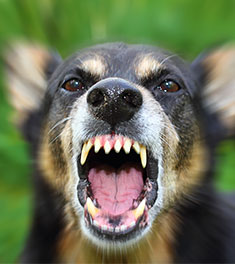
What to do for a Dog Bite
DOG BEHAVIOR Getting bitten by a dog can be scary, and you may be tempted to run around in circles for a while, trying to figure out what to do. Here's our guide to help you manage the situation.
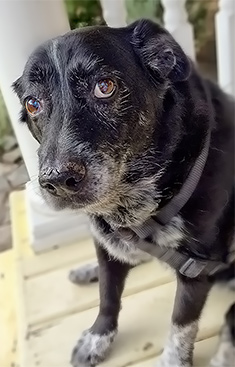
Top Ten Tips for Living with a Senior Dog
DOG HEALTH Bringing home a new puppy is so exciting, but it doesn’t take all that long for your exuberant puppy to grow into a senior dog who may have special needs. Here are the doggies.com top ten tips for taking care of your companion who has been with you through so much.