Mastiff Breed Guide
There’s no mistaking this extra-large dog from the working group. While the Great Dane may be taller, the robust Mastiff wins the size competition by virtue of his bulk. Mastiffs have been described as good-natured, courageous, dignified, and docile.
What do Mastiffs look like?
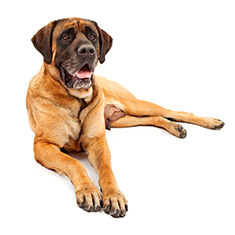
With his huge head, kindly black-masked facial expression, and gentle nature, this impressive dog is one of the largest recognized by the American Kennel Club. Male Mastiffs in the show ring must measure at least 30 inches at the shoulder, with females slightly shorter. They often weigh in excess of 200 pounds. In fact, the biggest dog ever documented was a 343-pound Mastiff named Zorba from England.
The breed standard for Mastiffs specifies only three colors for the short, smooth coat: fawn, apricot, or brindle. The head is massive, the forehead wrinkled, and much of the face is covered in a black mask. The broad skull gives the head a square appearance. The body should be rectangular – longer than it is wide, and the chest is very wide, resulting in legs that are set far apart from each other.
Where do Mastiffs come from?
Because this breed is sometimes called the English Mastiff, you’d be correct in assuming they were originally bred in England. The current standard of the breed is thought to have originated in medieval times; however, some version of the breed existed as far back as 3000 BC. Drawings on many ancient monuments in Egypt show a dog similar to today’s Mastiff.
In 55 BC, Julius Caesar wrote that his troops fought against a similar dog during the Roman invasion of Britain. Some of these dogs were taken back to Rome, where they were used as bull baiters, lion fighters, and even took part in fights with human gladiators. Meanwhile, back in merry old England, the Mastiff was used to protect hearth and home by keeping predators such as wolves at bay.
How does a Mastiff act?
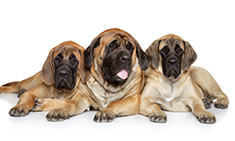
Although they were originally bred to be fearless warriors and watch dogs, the present-day Mastiff is known for his docile, gentle nature. Perhaps as a leftover from their fighting days, Mastiffs are known to be intensely loyal and powerful.
Mastiffs make wonderful guard dogs with no training required. Their innate desire to please their owners, coupled with their natural loyalty results in a dog who is more than up to the task of warding off intruders. However, unlike some other guard dogs who are valued for their aggressiveness, a Mastiff is more likely to simply knock down an intruder and sit on him than to attack.
According to the Mastiff Club of America, “Mastiffs excel as companions, family members, therapy workers, and as watch dogs. They are also great foot warmers and couch potatoes.”
These dogs are generally clean, although they have been known to slobber quite a bit. They rarely bark, and will not bite unless incited to do so. They do like to dig holes, but become reasonably sedentary as they outgrow their puppy-hood. Intense exercise is not recommended for any of the giant dogs before the age of two years, as their joints are still developing and may easily become inflamed.
Like most breeds, the Mastiff prefers indoor living, where he or she can be with family, to outdoor kenneling or living in a dog house. Some breeders will not even sell you a Mastiff puppy unless you promise to keep the dog in the house. It is believed that their emotional development can be stunted if they are not provided a way to stay as close as possible to their human families.
A Mastiff by any other name…still a Mastiff?
The Mastiff, as recognized by the American Kennel Club, is also sometimes called an English Mastiff. The two terms are interchangeable. However, the other Mastiff breeds are distinct and separate.
The Bull Mastiff is a cross between an English Mastiff and a Bulldog. The Bull Mastiff is smaller than the English variety.
The Neapolitan Mastiff is shorter than the Bull and English types, and carries a body full of wrinkles, from head to tail.
The French Mastiff, also known as the Dogue de Bordeaux, is shorter than the others, and is often red in color.
The Tibetan Mastiff has a longer coat and comes in a variety of colors, in contrast to the short, smooth coats of all of the other types.
People who don’t pay close attention may call any of these breeds a “Massive”. It is fitting because of their large size, but not correct.
Training, Grooming, and Feeding a Mastiff
Mastiffs have an intense desire to please and are easily trained using positive training methods. Because of their immense size and strength, early training and socialization are absolute requirements to having this breed in your home. It’s much easier to teach a puppy not to jump up than it is to work with a 200-pound locomotive who has never been taught his manners.
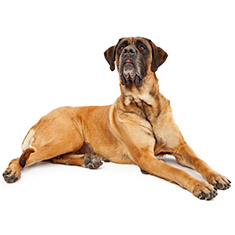
Grooming requirements are slight for this breed. A good brushing once a week or so should be sufficient to keep the dog clean, and a semi-annual bath will finish up the job. Mastiffs shed, particularly twice a year as the seasons change, but the fur is short and relatively easy to sweep up. Regular brushing will help keep most of the fur off of your carpets and furniture.
It is best to feed the Mastiff two or three times each day. Feeding a dog this large just one large meal can result in bloat, a veterinary emergency where the stomach twists on itself. Smaller meals are thought to lessen the occurrence of this sometimes fatal condition.
Is the Mastiff the right breed for me?
If you have a home and yard large enough for a Mastiff to get some exercise, you have met the first qualification for having an extra-large breed. Beyond that, you should be prepared to put up with moderate shedding, lots of drooling, and some back yard hole digging. Barking is minimal, and this companion dog is good with children and other animals.
You can expect your Mastiff to live about seven years, although many of them live to the ripe old age of 10 or even older.

Doggies Den: Latest Articles
 Homemade Thanksgiving Treats for Your Dog
NUTRITION We all want to include our dogs in our holiday celebrations, but hopefully, you're aware that sharing table scraps with your dog isn't always the best idea.
 Keeping Your Dog Safe during the Summer Months
HEALTH Summer is coming on fast, so it’s time to plan how you will keep your dog safe and healthy through the lazy, carefree, warm days.
 Vaccination Time Again-Keeping Your Puppy Healthy
DOG HEALTH So you have your new puppy picked out. There are quite a few shots, treatments and examinations that will keep the newest member of your family healthy.
 Canine Thanksgiving Feast
NUTRITION With the wide variety of food at Thanksgiving dinner, chances are you'll want to give your dog something special, too. If you're contemplating what to feed your dog for the holiday, here is a guide to a great Canine Thanksgiving Feast.
 Dog Walking Tips Every Owner Should Know
DOG FUN Walking your dog is not only crucial to keeping him healthy and happy, it strengthens the bond between your canine friend and his caregiver. There are a lot of obstacles out there. Don’t forget these simple tips to keep your walk fun and safe in the outside world.
 The Benefits of Physiotherapy for your Dog
HEALTH The same techniques that physiotherapists use to treat a variety of injuries and conditions in humans have been adapted to suit animals with great success. Family pets, show dogs, and working dogs can all benefit greatly from physiotherapy. Dogs whose activities involve a lot of agility are especially susceptible to the types of problems that physiotherapy can address.
 The Decision- Adding a Dog to Your Family
FIRST TIME OWNERSBringing a dog into your family is a decision where many people don’t realize it’s magnitude until after they have the dog. There are a number of things that you need to research before you decide to purchase a dog, and it starts right in your own home.
 Bringing Your Dog Into Your New Baby's Life
HEALTH Many believe that a dog and a new baby cannot happily coexist, so therefore the dog has to go. This is not necessarily the case.  A new baby does not mean you have to abandon your dog.

Doggies Den:
Most Popular Articles
Dog Pregnancy Symptoms
HEALTHIf you suspect your dog might be pregnant, check out part one in this series on pregnant dogs, where we cover pregnant dog symptoms.
Dog Birth
HEALTHIn the third article of our dog pregnancy series, we look at the wonderful, but messy, process of bringing newborn puppies into the world.
Indoor Dog Potties
DOG PRODUCTSIt's been a long day at work. You were so busy, you didn't even take time to eat a sandwich, let alone run home to let your dog out. You're on your way home, knowing the poor dog is crossing his or her legs by now, when your car breaks down, delaying you even further. Can't somebody make this easier?
Your Dog’s Digestive System
PHYSIOLOGYEver wonder why your dog eats so fast? Or why he eats gross things? Or why he gets sick to his stomach? Or why his waste stinks so bad? Some of these things are normal, some are not.
Canine Respiratory System
BREATHINGThe basic function of your dog's respiratory system is to bring oxygen in to and remove carbon dioxide from the body. Knowing the symptoms of respiratory diseases can help you help your stay healthy.
Shelter Dog Adoption Tips for Success
ADOPTION Are you intimidated by the prospect of "rescuing" a dog from a shelter? One reason that you may be wary of adopting a dog from a shelter is not knowing how to choose. Adopting a dog from a shelter can be a rewarding process, if you're prepared to do a reasonable amount of research.
Canine Urinary Tract Infections
SYMPTOMS AND TREATMENTDoes your dog seem to be having trouble relieving his or her bladder? Learn how to recognize the signs of urinary tract infections and how to treat them before they spread.
What to do for Dog Diarrhea
SYMPTOMS AND REMEDIESIf you have dogs in your house for any length of time, you have likely experienced at least one bout of dog diarrhea. Beyond the pain in the tuckus involved in cleaning up the mess, you should know what causes diarrhea, and when it's important to see the vet.
What to do for a Dog Bite
DOG BEHAVIOR Getting bitten by a dog can be scary, and you may be tempted to run around in circles for a while, trying to figure out what to do. Here's our guide to help you manage the situation.
Top Ten Tips for Living with a Senior Dog
DOG HEALTH Bringing home a new puppy is so exciting, but it doesn’t take all that long for your exuberant puppy to grow into a senior dog who may have special needs. Here are the doggies.com top ten tips for taking care of your companion who has been with you through so much.