Canine Mange
Mange in dogs occurs in two forms, sarcoptic mange, also called scabies, and demodectic mange, which may be called red mange or follicle mange. Demodectic mange is the more common of the two types. Both types are caused by mites that burrow into the dog’s skin to cause intense itching.
Sarcoptic Mange
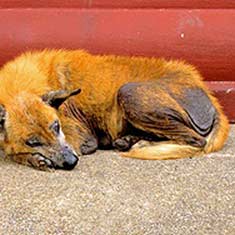
Sarcoptic mange usually occurs in young strays, but can occur in any dog of any age. The mites are usually localized to small areas, particularly those without much hair, such as the chest, ears, elbows, or belly. After the mite burrows just under the surface of the dog’s skin, it lays eggs which hatch into nymphs and larvae. As the nymphs and larvae grow, they feed on the dog’s skin causing hair loss and crusty, red-brown sores. When the ears are involved, the tips will become crusty.
To check your dog for scabies, your vet will scrape some of his skin and look at it under a microscope. However, if the dog has killed the mites in that area by scratching, the vet may find only a few mites, or even no mites at all, but the skin sores are distinctive enough that she will make what is called a “presumptive” diagnosis, meaning that no definitive proof has been found.
Scabies is very contagious, not only to other dogs, but also to cats and people. The mites cannot go through a complete life cycle in humans, but they do cause itching and misery until they die out. If your dog has been diagnosed with sarcoptic mange and any family member develops an itchy rash, be sure to tell your physician about your dog’s diagnosis.
Treatment of Sarcoptic Mange
Treatment for your dog is accomplished by dipping the dog into a petroleum-based chemical such as Amitraz. Sold under several brand names, Amitraz is available without a prescription. However, you should consult your vet before using the dip, as it is slightly toxic. Treatment involves bathing your dog once weekly for four weeks, with each bath following by the application of the dipping solution. Your dog may experience a decrease in body temperature, loss of appetite, vomiting, and diarrhea following treatment with Amitraz.
The heartworm medicine, Ivermectin, may also be effective against sarcoptic mites, but this drug is dangerous to most herding dogs. With either treatment, your dog should stop itching in about five days. If not, your vet should be informed.
In addition to dipping the dog, his environment must be cleaned to get rid of all of the mites. Sarcoptic mites can live for several days on hard floors, in carpet, on grooming tools, and in bedding. Your normal cleaning routine should eliminate the mites from your home; however, anything that isn’t terribly expensive is best thrown away. The dog’s bedding should be washed in hot water and bleach if throwing it away is not possible.
Demodectic Mange
Demodectic mange mites burrow much more deeply into the skin than do sarcoptic mange mites. They live deep within the hair follicles of most dogs, but only those who do not have immunity to them will suffer from symptoms. This most frequently occurs in very young dogs and very old dogs or others with weakened immune systems. This type of mange is generally not contagious, as most dogs have demodectic mange mites on their skin anyways.
Symptoms generally begin around the eyes, but can spread to the head or elsewhere on the body. Localized mange is when symptoms occur only in one area, while generalized mange occurs when the symptoms spread to larger areas of the body. The primary symptom is hair loss accompanied by scaly, crusty skin. Curiously, demodectic mange does not cause much itching. The lesions, especially if they are generalized, may become secondarily infected, causing inflammation, reddening of the skin, oozing of pus or blood, and a very strong odor. The reddening of the skin is what led to the name “red mange”.
The immune system’s inability to prevent generalized mange is genetically determined, so littermates of an affected puppy should watch carefully for symptoms. In addition, dogs who have had mange or who have produced puppies with mange should not be bred again.
Treatment of Demodectic Mange
Localized mange is treated with ointments that are applied directly to the affected area once daily for 10 – 14 days. For generalized mange, the dog must be bathed with a special shampoo to flush the mites out of the hair follicles. After bathing, the dog is then dipped with Amitraz. If the dog has developed a secondary skin infection, antibiotics may need to be added to the treatment regimen. Ivermectin may also be used in non-herding dogs to treat demodectic mange.
Although treatment is very often successful, it rids the dog of mites, but does not correct the underlying immune system defect. Therefore, it is not uncommon to see relapses. Each outbreak should be promptly treated to prevent the disease from spreading out of control. If the problems start in puppyhood, the dog’s immune system may develop enough as the dog grows to stop the outbreaks. However, in old age, the disease may flare up again as immune system functioning declines.
Amitraz Dipping
Amitraz is a pesticide, similar to those you might use in your garden. As such, it is toxic, and care must be taken to keep the chemical off of your body. Rubber gloves should be worn during the dipping, and you must take care to wash your hands and arms after treating your dog.
To mix the dipping solution, one bottle of Amitraz is diluted in two gallons of water. It is then poured over the dog, making sure it is generously applied to the affected areas. The dip is not rinsed off, and the dog should be dried with a hair dryer or allowed to air dry. If any of the dipping solution is left over after a treatment, it must be discarded.
If your dog has sores on his feet, 1 cc of Amitraz is mixed with 1 oz of propylene glycol and applied directly to the lesions 2 – 3 times each week. At the end of the week, this solution is also discarded and a fresh solution is mixed.
If the dog begins vomiting within a day or two of treatment, the dip should be diluted with 2-1/2 gallons of water for the next treatment.
After the third treatment for demodectic mange, or the fourth treatment for sarcoptic mange, the dog should be examined by your vet to check for any remaining live mites or eggs.

Doggies Den: Latest Articles
 Homemade Thanksgiving Treats for Your Dog
NUTRITION We all want to include our dogs in our holiday celebrations, but hopefully, you're aware that sharing table scraps with your dog isn't always the best idea.
 Keeping Your Dog Safe during the Summer Months
HEALTH Summer is coming on fast, so it’s time to plan how you will keep your dog safe and healthy through the lazy, carefree, warm days.
 Vaccination Time Again-Keeping Your Puppy Healthy
DOG HEALTH So you have your new puppy picked out. There are quite a few shots, treatments and examinations that will keep the newest member of your family healthy.
 Canine Thanksgiving Feast
NUTRITION With the wide variety of food at Thanksgiving dinner, chances are you'll want to give your dog something special, too. If you're contemplating what to feed your dog for the holiday, here is a guide to a great Canine Thanksgiving Feast.
 Dog Walking Tips Every Owner Should Know
DOG FUN Walking your dog is not only crucial to keeping him healthy and happy, it strengthens the bond between your canine friend and his caregiver. There are a lot of obstacles out there. Don’t forget these simple tips to keep your walk fun and safe in the outside world.
 The Benefits of Physiotherapy for your Dog
HEALTH The same techniques that physiotherapists use to treat a variety of injuries and conditions in humans have been adapted to suit animals with great success. Family pets, show dogs, and working dogs can all benefit greatly from physiotherapy. Dogs whose activities involve a lot of agility are especially susceptible to the types of problems that physiotherapy can address.
 The Decision- Adding a Dog to Your Family
FIRST TIME OWNERSBringing a dog into your family is a decision where many people don’t realize it’s magnitude until after they have the dog. There are a number of things that you need to research before you decide to purchase a dog, and it starts right in your own home.
 Bringing Your Dog Into Your New Baby's Life
HEALTH Many believe that a dog and a new baby cannot happily coexist, so therefore the dog has to go. This is not necessarily the case.  A new baby does not mean you have to abandon your dog.

Doggies Den:
Most Popular Articles

Dog Pregnancy Symptoms
HEALTHIf you suspect your dog might be pregnant, check out part one in this series on pregnant dogs, where we cover pregnant dog symptoms.
Dog Birth
HEALTHIn the third article of our dog pregnancy series, we look at the wonderful, but messy, process of bringing newborn puppies into the world.

Indoor Dog Potties
DOG PRODUCTSIt's been a long day at work. You were so busy, you didn't even take time to eat a sandwich, let alone run home to let your dog out. You're on your way home, knowing the poor dog is crossing his or her legs by now, when your car breaks down, delaying you even further. Can't somebody make this easier?

Your Dog’s Digestive System
PHYSIOLOGYEver wonder why your dog eats so fast? Or why he eats gross things? Or why he gets sick to his stomach? Or why his waste stinks so bad? Some of these things are normal, some are not.

Canine Respiratory System
BREATHINGThe basic function of your dog's respiratory system is to bring oxygen in to and remove carbon dioxide from the body. Knowing the symptoms of respiratory diseases can help you help your stay healthy.

Shelter Dog Adoption Tips for Success
ADOPTION Are you intimidated by the prospect of "rescuing" a dog from a shelter? One reason that you may be wary of adopting a dog from a shelter is not knowing how to choose. Adopting a dog from a shelter can be a rewarding process, if you're prepared to do a reasonable amount of research.
Canine Urinary Tract Infections
SYMPTOMS AND TREATMENTDoes your dog seem to be having trouble relieving his or her bladder? Learn how to recognize the signs of urinary tract infections and how to treat them before they spread.

What to do for Dog Diarrhea
SYMPTOMS AND REMEDIESIf you have dogs in your house for any length of time, you have likely experienced at least one bout of dog diarrhea. Beyond the pain in the tuckus involved in cleaning up the mess, you should know what causes diarrhea, and when it's important to see the vet.

What to do for a Dog Bite
DOG BEHAVIOR Getting bitten by a dog can be scary, and you may be tempted to run around in circles for a while, trying to figure out what to do. Here's our guide to help you manage the situation.
Top Ten Tips for Living with a Senior Dog
DOG HEALTH Bringing home a new puppy is so exciting, but it doesn’t take all that long for your exuberant puppy to grow into a senior dog who may have special needs. Here are the doggies.com top ten tips for taking care of your companion who has been with you through so much.