Canine Heartworm
Heartworm, the parasitic roundworm spread by mosquitoes, can affect cats, wolves, coyotes, foxes, and even humans. However, the animal most at risk from heartworm is the dog. The scientific name, Dirofilaria immitis, is rarely used, in favor of the term heartworm, which arose because the adult worm lives primarily in the right ventricle of the heart.
Where did heartworm come from?
The first recorded incidence of heartworm in a dog in the United States was in 1847. At that time, the disease was known only in the southern United States, but has since spread nearly everywhere the mosquito is found. As one might expect, the incidence is highest in southern coastal areas and along the Mississippi River, and lower as you travel northward. Alaskan dogs are rarely infected.
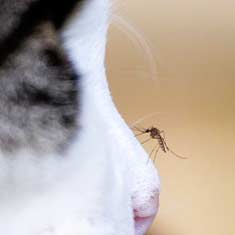
Because the worm is a parasite, it requires a host to survive. The intermediate life stage has two requirements: a mosquito and about two weeks of temperatures above 80 degrees. In fact, if the temperature falls below 57 degrees, the worm dies. This temperature requirement explains the fact that the worm has a preference for Southern States. Depending on where you live, you will give your dog his heartworm preventative during different months, based on the expected mosquito season in your area. In the South, you may give prophylaxis year round, while in the Midwest, you may only need it from May to December.
Life Cycle of the Heartworm
The infected mosquito, like all mosquitoes, seeks blood for its meal, which it gets by biting a warm-blooded mammal such as a dog. During its snack, the mosquito deposits the third-stage heartworm larvae under the skin of the dog, where they live for a week or two before molting into their fourth stage. After molting, they migrate to the muscles of the chest and abdomen, where they live for 1-1/2 to 2 months before molting again to the fifth larval stage, that of immature adults.
After 30 to 60 days, the heartworms enter the bloodstream and end up in the pulmonary artery, where they grow much larger over the next 3 to 4 months. Females end up being about a foot long, while males are around 9 inches with a coiled tail. One dog may have as many as 250 adult worms, the sheer volume of which creates symptoms because of the room they take up.
The adult worms mate and give birth to thousands of live young, known as microfilariae, which circulate throughout the bloodstream of the dog for as long as two years. Eventually, the dog is bitten by another mosquito, which results in the microfilariae being picked back up by the mosquito, where they go through a series of molts until they get back to the third larval stage. At this stage, they migrate to the mosquito’s salivary glands and are injected back into another unsuspecting dog.
It is important to note that although a dog with an active heartworm is infectious, he cannot pass the worm directly to another dog. The heartworm must first be passed to a mosquito to mature through its first larval stages, then be passed back to another dog.
How do I know if my dog has heartworm?
During the six months that the heartworms are developing into adults, the dog will show no indication of an infection, and cannot be detected by blood test. Even dogs carrying mature worms may not show any signs of infection, particularly if the infection is reasonably light and the dog is fairly inactive. Dogs carrying a heavier worm load and those who are normally active will show the classic symptom of a cough especially when active, and will tire easily. Untreated, the adult worms continue to build up in the heart, leading to severe weight loss, fainting, coughing up blood, and congestive heart failure.
The best test to detect heartworm is a blood test to detect the antigens released by the female worm’s reproductive tract. An antigen is a substance to which the dog’s body can mount an immune response. The antigen which triggers a positive blood test is very specific to the heartworm, meaning that the test will not give a false positive for other organisms. The test is also very sensitive, meaning that it will detect an infection 90% of the time when one is present. The infections the blood test misses are usually due to a low worm load, infections which have not yet advanced to the adult worm stage, and infections which contain only male worms.
Dogs should always be tested for heartworm before being started on a heartworm preventative because the medication can be fatal to a dog who has an active infection with adult heartworm. In addition, the sudden death of all of the microfilariae can cause shock in the dog. Finally, a heartworm preventative will kill only a few of the adult heartworms, leaving the dog infected, perpetually forever, leading to further heart and lung damage.
What happens if the test turns out positive?
If your dog’s blood test turns out positive for heartworm, your vet may order a concentrating filter test to look for the presence of microfilariae. X-rays may then be used to see how much lung damage has resulted from the worms. In addition, the dog’s heart, liver and kidney function must be checked to see if he can withstand the heartworm treatment.
Adult worms are killed with a compound made of arsenic and marketed under the name of Immiticide, usually given in four doses over the course of two days. The treatment, as well as the worms, can cause blood platelets to stick together and may cause damage to the blood vessels. For this reason, aspirin was at one time given to dogs when they were being treated for heartworm. However, the American Heartworm Society no longer recommends this treatment as studies have not shown a benefit. The dog must be restricted from exercise for several weeks to allow his body time to absorb the dead worms. Exertion can cause the dead worms to break loose and travel to the lungs, resulting in death from respiratory failure.
In cases where the heart is extremely damaged, your vet may choose to surgically remove the adult heartworms.
The arsenic or surgery only kills or removes adult worms. Several weeks after the initial treatment, another week of treatment is given to get rid of the microfilariae or larval worms. The blood test is repeated, and if not negative, treatment continues with a higher dose. The dog is considered cured when blood tests come back negative.
Can I prevent my dog from becoming infected?
The good news is, yes, you can prevent heartworm, and you don’t even have to move to Alaska! After your vet has taken a blood test to assure that your dog is not currently infected, he will prescribe a preventive such as ivermectin, milbemycin, or moxidectin. These medications are available under brand names such as Heartgard, Interceptor, Sentinel, and ProHeart, as well as in a generic form. Both pills and chewables are available.
In addition, moxidectin was once given in the United States as a sustained-release injection, good for either 6-months or 12-months. It has since been removed from the market in the United States, but remains available in many other countries.
Finally, some preventives are provided as a topical treatment under the brand name of Advantage Multi and Revolution. Both of these medications prevent not only heartworm, but also other parasites such as roundworms, hookworms, whipworms, fleas, ticks, and mites.
All of these drugs average 95% effectiveness when properly used during the time of year that temperatures are expected to be above 57 degrees.
If you forget to give your dog his preventative, he should be re-tested for heartworm in about 7 months. The tests can only detect heartworm disease after the worms are seven months old, so it is important that you wait to test until the worms have had time to mature. In the meantime, monthly preventative treatments should be resumed.
Can I catch heartworm from my dog?
Although you technically could catch the disease, it is very, very rare for humans to become infected with heartworm. Even if the heartworm does enter your bloodstream, it would die shortly after reaching your lungs, and cause little more than a bit of respiratory distress. After the worm dies, a small granuloma nodule forms around the worm to absorb it back into your system. If you would happen to have a chest X-ray while the granuloma is present, you will likely be sent for a biopsy, as it mimics lung cancer on the X-ray. The biopsy is considered the biggest risk of human heartworm.
Should I treat my puppy for heartworm?
Puppies, even when they are still nursing, do not have any immunity to heartworm. In fact, the microfilariae may even pass through mother’s milk to the puppy. Remember, however, that microfilariae cannot develop into adult worms without first living in a mosquito, so they do not cause problems in puppies. They will be killed when a preventative medication is given. Young dogs can be started on heartworm prevention as early as four to eight weeks old. Check with your vet to see when she recommends beginning treatment.
Click to learn about other intestinal parasites and worms in dogs

Doggies Den: Latest Articles
 Homemade Thanksgiving Treats for Your Dog
NUTRITION We all want to include our dogs in our holiday celebrations, but hopefully, you're aware that sharing table scraps with your dog isn't always the best idea.
 Keeping Your Dog Safe during the Summer Months
HEALTH Summer is coming on fast, so it’s time to plan how you will keep your dog safe and healthy through the lazy, carefree, warm days.
 Vaccination Time Again-Keeping Your Puppy Healthy
DOG HEALTH So you have your new puppy picked out. There are quite a few shots, treatments and examinations that will keep the newest member of your family healthy.
 Canine Thanksgiving Feast
NUTRITION With the wide variety of food at Thanksgiving dinner, chances are you'll want to give your dog something special, too. If you're contemplating what to feed your dog for the holiday, here is a guide to a great Canine Thanksgiving Feast.
 Dog Walking Tips Every Owner Should Know
DOG FUN Walking your dog is not only crucial to keeping him healthy and happy, it strengthens the bond between your canine friend and his caregiver. There are a lot of obstacles out there. Don’t forget these simple tips to keep your walk fun and safe in the outside world.
 The Benefits of Physiotherapy for your Dog
HEALTH The same techniques that physiotherapists use to treat a variety of injuries and conditions in humans have been adapted to suit animals with great success. Family pets, show dogs, and working dogs can all benefit greatly from physiotherapy. Dogs whose activities involve a lot of agility are especially susceptible to the types of problems that physiotherapy can address.
 The Decision- Adding a Dog to Your Family
FIRST TIME OWNERSBringing a dog into your family is a decision where many people don’t realize it’s magnitude until after they have the dog. There are a number of things that you need to research before you decide to purchase a dog, and it starts right in your own home.
 Bringing Your Dog Into Your New Baby's Life
HEALTH Many believe that a dog and a new baby cannot happily coexist, so therefore the dog has to go. This is not necessarily the case.  A new baby does not mean you have to abandon your dog.

Doggies Den:
Most Popular Articles

Dog Pregnancy Symptoms
HEALTHIf you suspect your dog might be pregnant, check out part one in this series on pregnant dogs, where we cover pregnant dog symptoms.

Dog Birth
HEALTHIn the third article of our dog pregnancy series, we look at the wonderful, but messy, process of bringing newborn puppies into the world.

Indoor Dog Potties
DOG PRODUCTSIt's been a long day at work. You were so busy, you didn't even take time to eat a sandwich, let alone run home to let your dog out. You're on your way home, knowing the poor dog is crossing his or her legs by now, when your car breaks down, delaying you even further. Can't somebody make this easier?

Your Dog’s Digestive System
PHYSIOLOGYEver wonder why your dog eats so fast? Or why he eats gross things? Or why he gets sick to his stomach? Or why his waste stinks so bad? Some of these things are normal, some are not.

Canine Respiratory System
BREATHINGThe basic function of your dog's respiratory system is to bring oxygen in to and remove carbon dioxide from the body. Knowing the symptoms of respiratory diseases can help you help your stay healthy.

Shelter Dog Adoption Tips for Success
ADOPTION Are you intimidated by the prospect of "rescuing" a dog from a shelter? One reason that you may be wary of adopting a dog from a shelter is not knowing how to choose. Adopting a dog from a shelter can be a rewarding process, if you're prepared to do a reasonable amount of research.

Canine Urinary Tract Infections
SYMPTOMS AND TREATMENTDoes your dog seem to be having trouble relieving his or her bladder? Learn how to recognize the signs of urinary tract infections and how to treat them before they spread.

What to do for Dog Diarrhea
SYMPTOMS AND REMEDIESIf you have dogs in your house for any length of time, you have likely experienced at least one bout of dog diarrhea. Beyond the pain in the tuckus involved in cleaning up the mess, you should know what causes diarrhea, and when it's important to see the vet.

What to do for a Dog Bite
DOG BEHAVIOR Getting bitten by a dog can be scary, and you may be tempted to run around in circles for a while, trying to figure out what to do. Here's our guide to help you manage the situation.
Top Ten Tips for Living with a Senior Dog
DOG HEALTH Bringing home a new puppy is so exciting, but it doesn’t take all that long for your exuberant puppy to grow into a senior dog who may have special needs. Here are the doggies.com top ten tips for taking care of your companion who has been with you through so much.