Dog Behavior and You Part 3
Dog Behavior and You: Part 1
Dog Behavior and You: Part 2
For the safety of you and your family, learn the signs of dog aggression, and what to do if confronted by an aggressive animal.
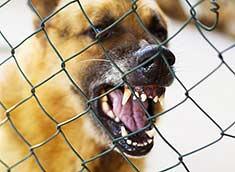
In the first two installments of this series, we talked about confident dogs and fearful dogs. Although both of these emotions may affect your relationship with your dog, probably the most important type of dog to be aware of is the aggressive dog. Most dogs are friendly and fun-loving, wanting nothing more than a pat on the head or a good belly rub, but there are some dogs who are just flat-out mean. Whether this is the result of bad breeding or bad socialization, or even just because the dog is having a bad day, for your own protection and that of your children, you must learn how to recognize an aggressive dog and what to do when you encounter one.
An Aggressive Dog May Bark…or Not
The signal most of us have probably heard from an aggressive dog is growling. Some dogs will give a low-throated growl as a warning before they attack. However, a truly aggressive dog may give no warning at all. Some dogs who have been trained as attack dogs have also had their vocal chords removed so that they will not give an intruder any warning prior to assaulting him. These silent attacks are common in guard dogs, particularly if illegal activity is occurring at the dog’s home.
If the dog does still have his vocal chords, he may also begin to bark loudly when he is preparing to attack. This activity is meant to scare away any threats. The dog knows that in any fight, he stands a chance of getting injured. He would much rather an intruder become scared and go away, but an aggressive dog is prepared to fight if necessary. The major reason an otherwise calm dog becomes aggressive is to protect his home and family. Anything he perceives as a threat will be dealt with in a hurry.
Bared Teeth, Flattened Ears
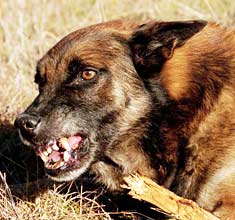
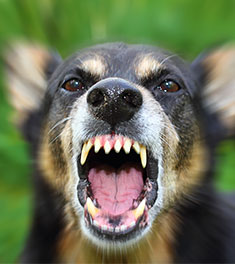
An aggressive dog may pull his lips back into a snarl. This motion bares his teeth and wrinkles the muzzle. This action is designed to intimidate possible attackers. A dog who is baring his teeth is easy to distinguish from a dog who is merely “smiling” or panting. The wrinkled muzzle is the key. While other actions may result in the teeth being exposed so you can see them, the wrinkled muzzle teeth-baring pulls the upper lip out of the way so it will not be bitten when the dog sinks his teeth into someone else.
An aggressive dog’s ears will be pinned back close to his head. Remember, he is getting ready to fight; he doesn’t want to leave anything sticking out, where it can easily be bitten off. Take your cue from this action. You also should keep things like your fingers tucked in where they are less likely to be grabbed by sharp teeth. If you would happen to be knocked down by an aggressive dog, cover your ears so they are not such an easy target to grab.
Eyes Not Best Indicator of Aggression
The eyes of an aggressive dog may be wide open to take in all of his surroundings, as he is on hyper-alert status. On the other hand, dogs may narrow their eyes before an attack. The eyes are not necessarily a reliable indicator of aggression. As was discussed last week, a fearful dog may develop “whale eyes” where the whites of the eyes show as the dog looks out of the corners of his eyes. This is in contrast to an aggressive dog, who will look directly at the target of his aggression. To a dog, looking directly at someone is a sign of dominance, a challenge to see if the other dog (or person) will look away first. Do you remember having staring contests when you were a kid? Dogs exhibit similar behavior, and to look away first indicates submission.
Tense and Ready
The dog who is exhibiting aggression will have a very tense body stance. He will likely be leaning forward, in the direction he intends to attack. His legs will be straight and his hackles may be up. If you have been reading this feature regularly, you will remember that the hackles are the fur running along the dog’s spine. Raised hackles are difficult to see in a long-haired dog, but very distinctive in a short-haired dog. The fur, particularly at the shoulders and at the base of the tail, literally stands on end.
The tail is generally held straight out from the body when a dog is being aggressive. The fur is fluffed out to make the tail seem larger. This, as well as the raised hackles, is an attempt by the dog to make himself seem larger. Just as a cat will puff out his fur when threatened, a dog tries to make himself seem bigger and more intimidating than he actually is, in hopes he will scare off whatever is threatening his home or family.
What to Do Around an Aggressive Dog
This installment would not be complete if I didn’t tell you what to do when you encounter an aggressive dog. Statistics show that as many as 50% of children are bitten before the age of 12 years, so be sure to review this information with your kids. When confronted by an aggressive dog, your first instinct may be to run away. This is one of the worst things you can do. If you turn your back on the dog, he will be able to sneak up behind you, and if you run, he will assume you are prey and will try to tackle you. It is far better to back away from an aggressive dog. Shuffle your feet as you walk to lessen the chances that you will trip. Avoid direct eye contact; remember the dog sees this as a challenge. Keep your eyes on the dog to prevent a sneak attack, but do it from the corner of your eyes. If you have a purse, jacket, or something else with you, “feed” it to the dog if he tries to bite you. This may keep him occupied as you make your escape. If you have an umbrella, opening it in the dog’s face may scare him off. Many utility meter readers use a modified umbrella called the Bite Terminator® for this very reason.
If an aggressive dog knocks you down, curl into a ball and cover your ears with your hands. Curling up tightly will expose very few of your vital organs to the dog. He will mostly be able to bite your arms, legs, buttocks, and back, none of which contain life sustaining organs. In addition, curling into a ball protects your major arteries in the arms and legs, so chances are you will not bleed to death while awaiting help. Report all dog bites to the dog warden or health department so the proper follow-up can be done with the animal. The dog must be quarantined for 10 days after the bite, and examined on the 11th day for signs of rabies. In addition, most states have laws regarding vicious dogs. If you feel you were bitten because the dog’s owner did not properly obey the law, you may be able to file a criminal complaint.
Be Responsible for Your Dog
Finally, if you own an aggressive dog, make sure you keep him properly contained and under your control. Use a muzzle when you have him around other people, and lock him in another room when you have guests. Simply holding your dog may not be sufficient. Many meter readers and postal workers have been attacked by a dog which was being held by the owner. Dogs are simply too strong and agile to be reliably contained by holding their collar or leash.
Okay, enough of the bad dogs! Next time, we’ll talk about the signs your dog will give you when he is in the mood to play.

Doggies Den: Latest Articles
 Homemade Thanksgiving Treats for Your Dog
NUTRITION We all want to include our dogs in our holiday celebrations, but hopefully, you're aware that sharing table scraps with your dog isn't always the best idea.
 Keeping Your Dog Safe during the Summer Months
HEALTH Summer is coming on fast, so it’s time to plan how you will keep your dog safe and healthy through the lazy, carefree, warm days.
 Vaccination Time Again-Keeping Your Puppy Healthy
DOG HEALTH So you have your new puppy picked out. There are quite a few shots, treatments and examinations that will keep the newest member of your family healthy.
 Canine Thanksgiving Feast
NUTRITION With the wide variety of food at Thanksgiving dinner, chances are you'll want to give your dog something special, too. If you're contemplating what to feed your dog for the holiday, here is a guide to a great Canine Thanksgiving Feast.
 Dog Walking Tips Every Owner Should Know
DOG FUN Walking your dog is not only crucial to keeping him healthy and happy, it strengthens the bond between your canine friend and his caregiver. There are a lot of obstacles out there. Don’t forget these simple tips to keep your walk fun and safe in the outside world.
 The Benefits of Physiotherapy for your Dog
HEALTH The same techniques that physiotherapists use to treat a variety of injuries and conditions in humans have been adapted to suit animals with great success. Family pets, show dogs, and working dogs can all benefit greatly from physiotherapy. Dogs whose activities involve a lot of agility are especially susceptible to the types of problems that physiotherapy can address.
 The Decision- Adding a Dog to Your Family
FIRST TIME OWNERSBringing a dog into your family is a decision where many people don’t realize it’s magnitude until after they have the dog. There are a number of things that you need to research before you decide to purchase a dog, and it starts right in your own home.
 Bringing Your Dog Into Your New Baby's Life
HEALTH Many believe that a dog and a new baby cannot happily coexist, so therefore the dog has to go. This is not necessarily the case.  A new baby does not mean you have to abandon your dog.

Doggies Den:
Most Popular Articles
Dog Pregnancy Symptoms
HEALTHIf you suspect your dog might be pregnant, check out part one in this series on pregnant dogs, where we cover pregnant dog symptoms.
Dog Birth
HEALTHIn the third article of our dog pregnancy series, we look at the wonderful, but messy, process of bringing newborn puppies into the world.

Indoor Dog Potties
DOG PRODUCTSIt's been a long day at work. You were so busy, you didn't even take time to eat a sandwich, let alone run home to let your dog out. You're on your way home, knowing the poor dog is crossing his or her legs by now, when your car breaks down, delaying you even further. Can't somebody make this easier?
Your Dog’s Digestive System
PHYSIOLOGYEver wonder why your dog eats so fast? Or why he eats gross things? Or why he gets sick to his stomach? Or why his waste stinks so bad? Some of these things are normal, some are not.

Canine Respiratory System
BREATHINGThe basic function of your dog's respiratory system is to bring oxygen in to and remove carbon dioxide from the body. Knowing the symptoms of respiratory diseases can help you help your stay healthy.
Shelter Dog Adoption Tips for Success
ADOPTION Are you intimidated by the prospect of "rescuing" a dog from a shelter? One reason that you may be wary of adopting a dog from a shelter is not knowing how to choose. Adopting a dog from a shelter can be a rewarding process, if you're prepared to do a reasonable amount of research.
Canine Urinary Tract Infections
SYMPTOMS AND TREATMENTDoes your dog seem to be having trouble relieving his or her bladder? Learn how to recognize the signs of urinary tract infections and how to treat them before they spread.
What to do for Dog Diarrhea
SYMPTOMS AND REMEDIESIf you have dogs in your house for any length of time, you have likely experienced at least one bout of dog diarrhea. Beyond the pain in the tuckus involved in cleaning up the mess, you should know what causes diarrhea, and when it's important to see the vet.
What to do for a Dog Bite
DOG BEHAVIOR Getting bitten by a dog can be scary, and you may be tempted to run around in circles for a while, trying to figure out what to do. Here's our guide to help you manage the situation.
Top Ten Tips for Living with a Senior Dog
DOG HEALTH Bringing home a new puppy is so exciting, but it doesn’t take all that long for your exuberant puppy to grow into a senior dog who may have special needs. Here are the doggies.com top ten tips for taking care of your companion who has been with you through so much.